


Key facts.
- MAKER's reliability came from decomposing into focused microagents plus error correction and red-flagging at each step, a meta-layer that judged steps rather than trusting them. source
- PlanBench includes plan verification and replanning as distinct skills, and LLMs are weakest exactly where a meta-layer would catch problems, which is why a separate checker helps. source
- Hierarchical decomposition turns one long, unverifiable plan into many short, checkable sub-plans, which is the structural reason it improves reliability. source
What does a meta-reasoning layer actually do?
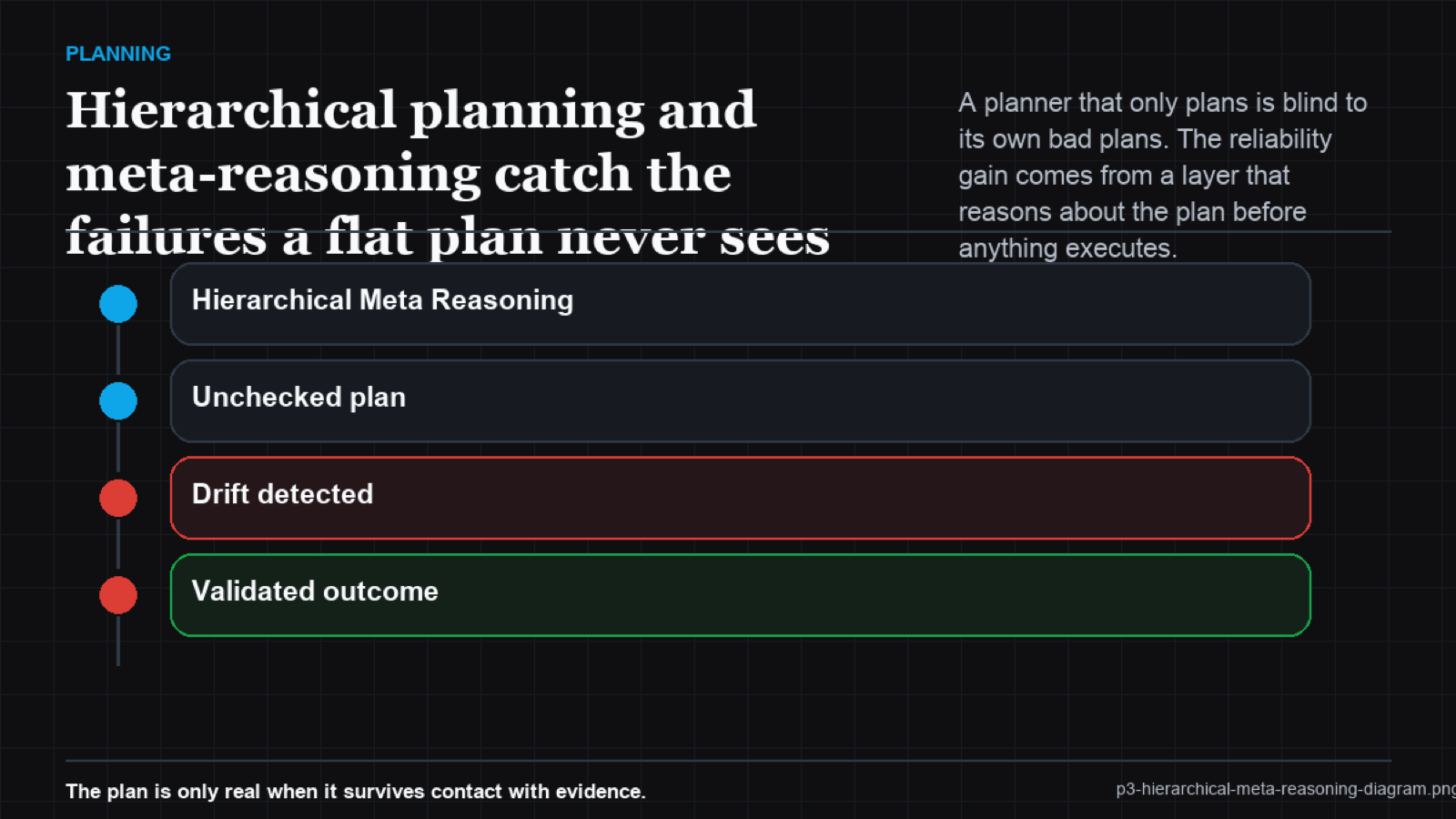
It separates proposing from judging. A flat planner proposes a plan and then executes it, with no step in between where anything asks whether the plan is sound. A hierarchical setup adds that step. A higher layer breaks the goal into sub-goals, checks that each sub-plan is coherent and within bounds and rejects or revises the ones that are not, before a single irreversible action fires. The value is not that the higher layer is smarter. It is that judging a plan is a different job from making one and doing both in a single pass means the planner grades its own work with no second opinion.
This is why decomposition matters beyond tidiness. A million-step plan cannot be checked as one object. Broken into short sub-plans, each one becomes small enough to verify and the meta-layer can act on each verification. The hierarchy is what makes checking tractable at all.
Where should the layer sit?
Above the planner and before execution. The planner produces sub-plans, the meta-layer validates them against goals and constraints and only validated sub-plans reach the executor. Where a sub-plan fails validation, it goes back for revision or escalates. You do not need a second giant model for this. You need a separate, cheaper check whose only job is to judge, because the planner cannot reliably judge itself.
| Architecture | Who judges the plan | Failure caught before execution? |
|---|---|---|
| Flat single-pass planner | The planner itself | Rarely |
| Hierarchical with meta-layer | A separate validation step | Often, per sub-plan |
That separation is what VibeModel provides as the Pattern Intelligence Layer. We model the patterns a sound plan follows and place the judging step where it belongs, above the planner and before execution, so bad branches are pruned by design rather than discovered in production.
Frequently asked questions
Would a stronger model remove the checking layer?
MAKER cleared a million steps via a separate layer judging each plan; a more capable model run flat makes one costly pass. (arXiv:2511.09030)
Isn't this just more agents to coordinate?
It is a check, not a crowd. The meta-layer judges plans; it does not need to be a full second agent to add value.
Does hierarchy add latency?
Some, but it replaces expensive failed executions with cheap rejected sub-plans, which usually nets out in your favor.
Can the same model do both jobs?
It can, but separating the prompt and the role for judging meaningfully outperforms one pass that both plans and grades itself.