

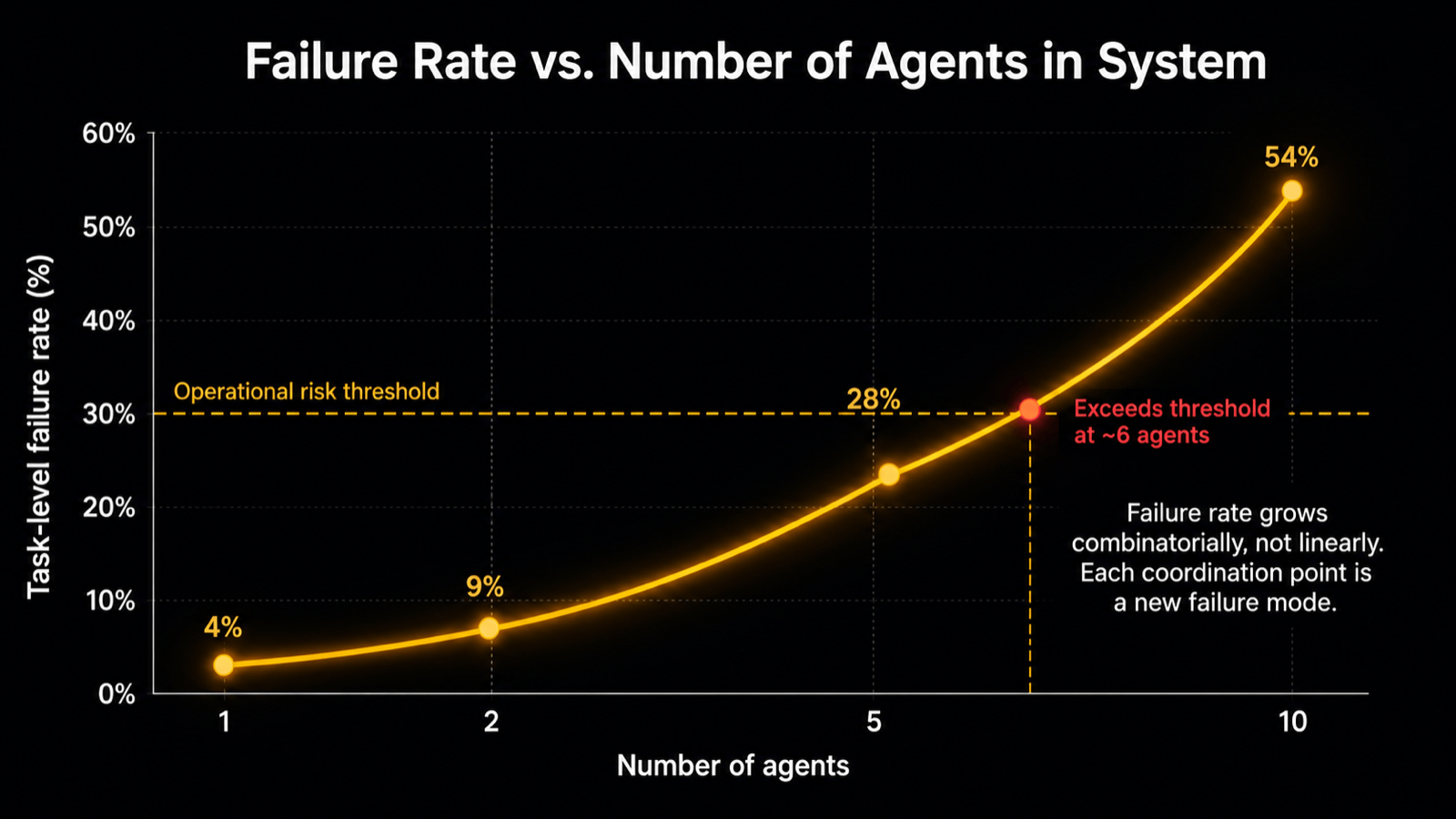
tau2-bench (arXiv:2506.07982, Jun 2025) extended the original tau-bench framework to more complex multi-party agentic workflows and found a pattern that holds consistently: pass rate drops as agent count grows, even when individual agent capability stays constant. The failure rate growth is non-linear, consistent with the n*(n-1)/2 combinatorial growth in inter-agent interaction channels. TRAIL (arXiv:2505.08638, May 2025) confirmed this from the trajectory evaluation side: as multi-agent trajectories extend in length and agent count, the probability of a fully correct trajectory falls at a rate that individual agent error rates alone don't explain. Coordination failures, which are a separate failure class from individual agent failures, account for the gap between what single-agent evaluations predict and what composed multi-agent systems actually deliver.
Key facts.
- tau2-bench (arXiv:2506.07982): extended multi-party workflow evaluation shows pass rates drop systematically and non-linearly as agent count increases; failure growth is consistent with n*(n-1)/2 coordination surface expansion. Individual agent capability held constant. Coordination failures are a distinct failure class invisible in single-agent evaluation.
- TRAIL (arXiv:2505.08638): trajectory evaluation in multi-agent tasks shows that fully correct trajectory probability falls faster than individual agent error rate predictions. The gap is attributable to coordination failures that don't surface in individual agent testing.
- The combinatorial math: a 2-agent system has 1 inter-agent interaction channel. A 5-agent system has 10 channels. A 10-agent system has 45 channels. At a conservative 5% per-interaction failure rate, the probability of zero failures in a full system run falls from 95% at 2 agents, to roughly 60% at 5 agents, to roughly 10% at 10 agents. That's before cascade effects, where one failure causes downstream failures.
Why failure grows faster than agent count
Three things combine and they're not independent. Coordination surface: inter-agent channels grow as n*(n-1)/2. Each channel is its own failure surface. Even with identical per-channel failure rates, the joint probability of zero failures collapses combinatorially as you add agents. I've watched teams add a sixth agent to a five-agent system and lose 20 percentage points of reliability they weren't expecting to lose. State complexity: shared state that must stay consistent across agents grows with agent count, and the probability of inconsistency grows with every agent writing to it. Cascade amplification: in a small system, one failure hits a small number of downstream agents. In a larger system, more agents depend on more agents. The cascade multiplier compounds. These aren't separate problems. They feed each other.
What the failure rates actually look like
There's no single universal table because failure rates depend on task complexity, coordination topology and which failure modes you're measuring. What the research does establish is direction and approximate magnitude. A 2-agent system on well-defined sequential tasks with explicit handoff schemas: coordination failure rates in the low single digits, comparable to single-agent rates. A 5-agent system with mixed sequential and parallel coordination on complex tasks: 15-30%, consistent with tau2-bench findings. A 10-agent mesh on open-ended tasks: 40-70%, consistent with the 41-87% range from arXiv:2605.03310. Those ranges widen with task complexity and narrow with explicit coordination controls.
Agent count decisions in practice
| Agent count | Coordination channels | Failure rate range (complex tasks) | Recommended control level |
|---|---|---|---|
| 2 | 1 | 3-8% | Basic handoff schema; completion signals |
| 3-4 | 3-6 | 8-20% | Typed protocols; shared state governance; failure detection |
| 5-7 | 10-21 | 20-45% | Full coordination layer; orchestration governance; production monitoring |
| 8+ | 28+ | 40-70%+ | PIL-class infrastructure required; formal protocol verification; graph-based monitoring |
The Pattern Intelligence Layer's value scales with agent count. For 2-agent systems, basic coordination controls close most of the failure rate gap. For systems with 8 or more agents, the failure rate without explicit coordination infrastructure sits in the range that makes production deployment infeasible. PIL is the coordination infrastructure that compresses the failure rate curve, keeping production failure rates manageable even at higher agent counts. The math does not reward large, uncoordinated multi-agent systems.
Frequently asked questions
Find where your agent breaks, from the goal, before you build it.