


Key facts.
- CVE-2025-8217 (Replit, Feb 2025): prompt injection in AI coding agent executed unintended commands because action verification did not confirm executed-vs-approved plan match.
- Time-to-detection without automated verification averages 4-6 hours for agentic workflow errors, per Gartner 2024 AI incident monitoring data.
- The majority of major AI production incidents investigated post-2023 had a detectable signal within the first 60 seconds of the error event - a signal that automated verification would have caught.
- Three escalation paths from minor to major: silent propagation (error runs undetected for hours), cascade triggering (downstream systems hit unexpected states), and external notification (wrong output reaches customer before detection).
The escalation mechanics
CVE-2025-8217 shipped because nothing confirmed the run matched the approved command; a better model runs it too.
A minor tool error without verification follows a predictable escalation pattern. At T+0, the tool returns an unexpected response - a soft error code, a partial result, a malformed payload. The agent does not verify the response. It treats the call as successful and proceeds. At T+5 minutes, the agent has completed the task based on the flawed tool response. The task is marked done. At T+30 minutes, a downstream process that depends on the agent's output encounters the corrupted state. It either fails loudly (triggering an alert) or compensates silently (masking the error further). At T+4 hours, a human reviews a report, notices a discrepancy, and begins incident investigation. At T+6 hours, the incident is scoped, and remediation begins.
The cost of remediation at T+6 hours is not the cost of the original tool error. It is the cost of four to six hours of downstream processing built on the corrupted state, plus the cost of scoping (determining the blast radius), plus the cost of reverting downstream effects, plus the cost of any external impact (customers notified, regulatory events triggered).
Verification at T+0 - immediately after the tool returns the unexpected response - catches the error before step two runs. Remediation cost: zero downstream work to undo, no external notifications sent, no incident scoping required. A minor tool error remains a minor tool error.
What verification needs to catch at T+0
Response schema validation: does the tool's response conform to the expected shape? A tool that returns an HTML error page instead of JSON is an immediate signal that something is wrong. Without schema validation, the agent may parse the HTML as best it can, extract a garbage value, and proceed.
State consistency check: does the tool's reported outcome match the expected system state? A database write that returns 200 OK but a subsequent read returns the pre-write value is a state inconsistency. Without a read-back check, the agent believes the write succeeded.
Plan-vs-execution alignment: did the executed action match the approved plan? This is the verification gap exploited by CVE-2025-8217. The agent had an approved plan; the injected prompt redirected execution. A check that confirms executed-action == approved-plan before proceeding would have caught the divergence.
# T+0 verification gate (catches errors before they propagate)
def verified_tool_call(tool, params, expected_state=None, approved_action=None):
 response = tool.call(params)Schema check
 if not response.conforms_to(tool.response_schema):
 raise VerificationError(f"Schema mismatch on {tool.name}: {response.raw}")
Plan alignment check
 if approved_action and not response.action_matches(approved_action):
 raise VerificationError(f"Executed action diverges from approved plan")
State consistency check
 if expected_state:
 actual_state = tool.read_state(expected_state.scope)
 if not expected_state.matches(actual_state):
 raise VerificationError(f"State inconsistency after {tool.name}")
 return response
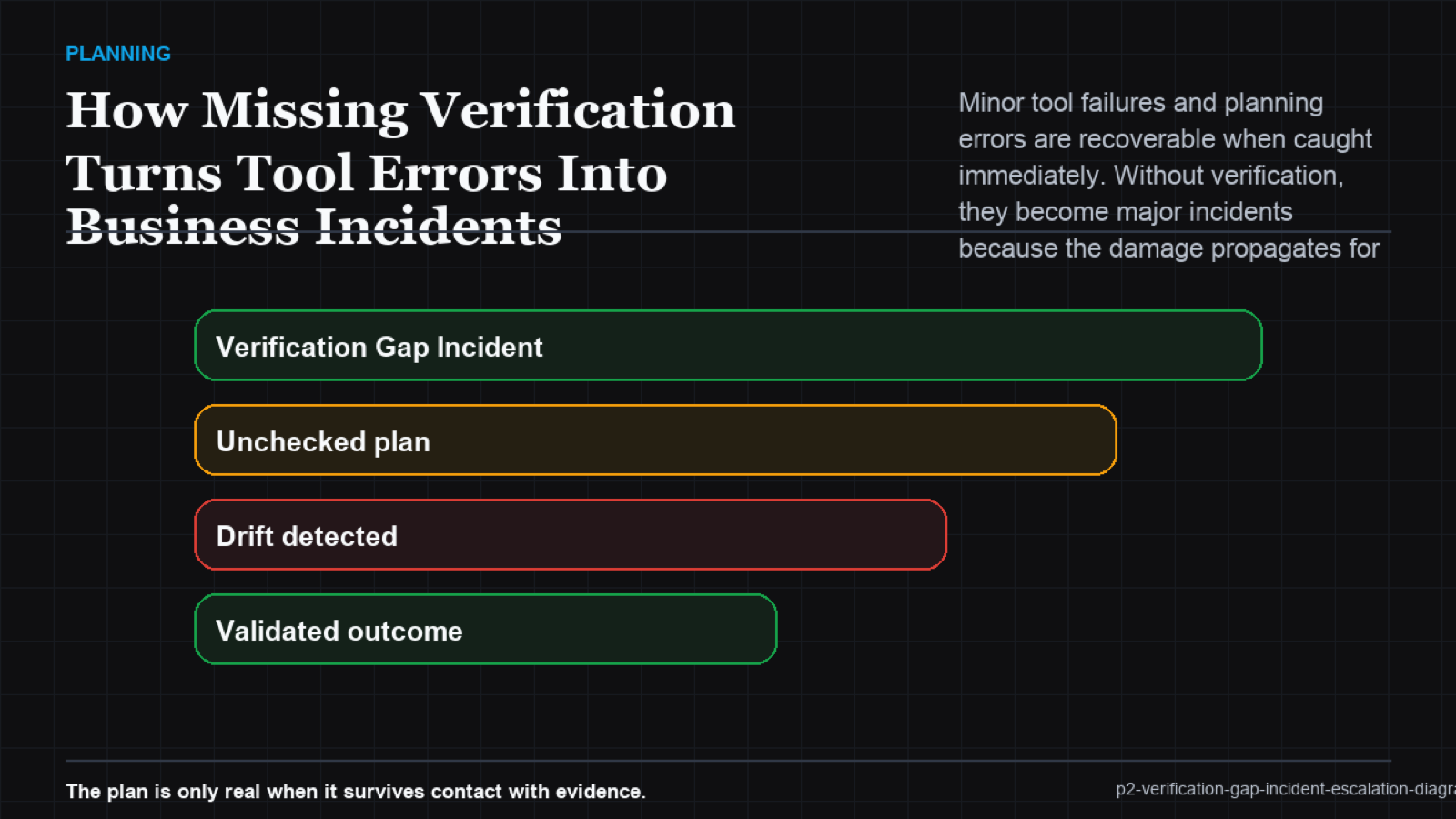
Escalation path comparison
| Detection point | Time | Propagation | External impact | Remediation scope |
|---|---|---|---|---|
| T+0 verification gate | Immediate | None | None | Single action retry or escalate |
| T+30m cascade failure | 30 minutes | 1-2 downstream steps | Rare | 2-3 system corrections |
| T+4h human review | 4-6 hours | Full pipeline | Possible | Full pipeline remediation |
| T+24h customer report | Next day | Full pipeline + external | Yes | Full remediation + customer recovery |
The Pattern Intelligence Layer defines the T+0 verification gate as a required component of every pattern that involves external tool calls. The gate specification - what schema to check, what state to read back, what plan-to-execution alignment to verify - is part of the pattern itself. Teams do not design this per tool, per deployment. It is already there.