


Key facts.
- SimpleQA shows even strong models fail simple, verifiable questions, so a technically completed run can still produce a wrong business result.source
- The EU AI Act frames accountability around what a high-risk system actually does and its outcomes, not merely whether it executed.source
Why do completion and success diverge?
A run that completes wrong looks just like one that completes right; even a more capable model fails SimpleQA, so completion hides a miss. (source)
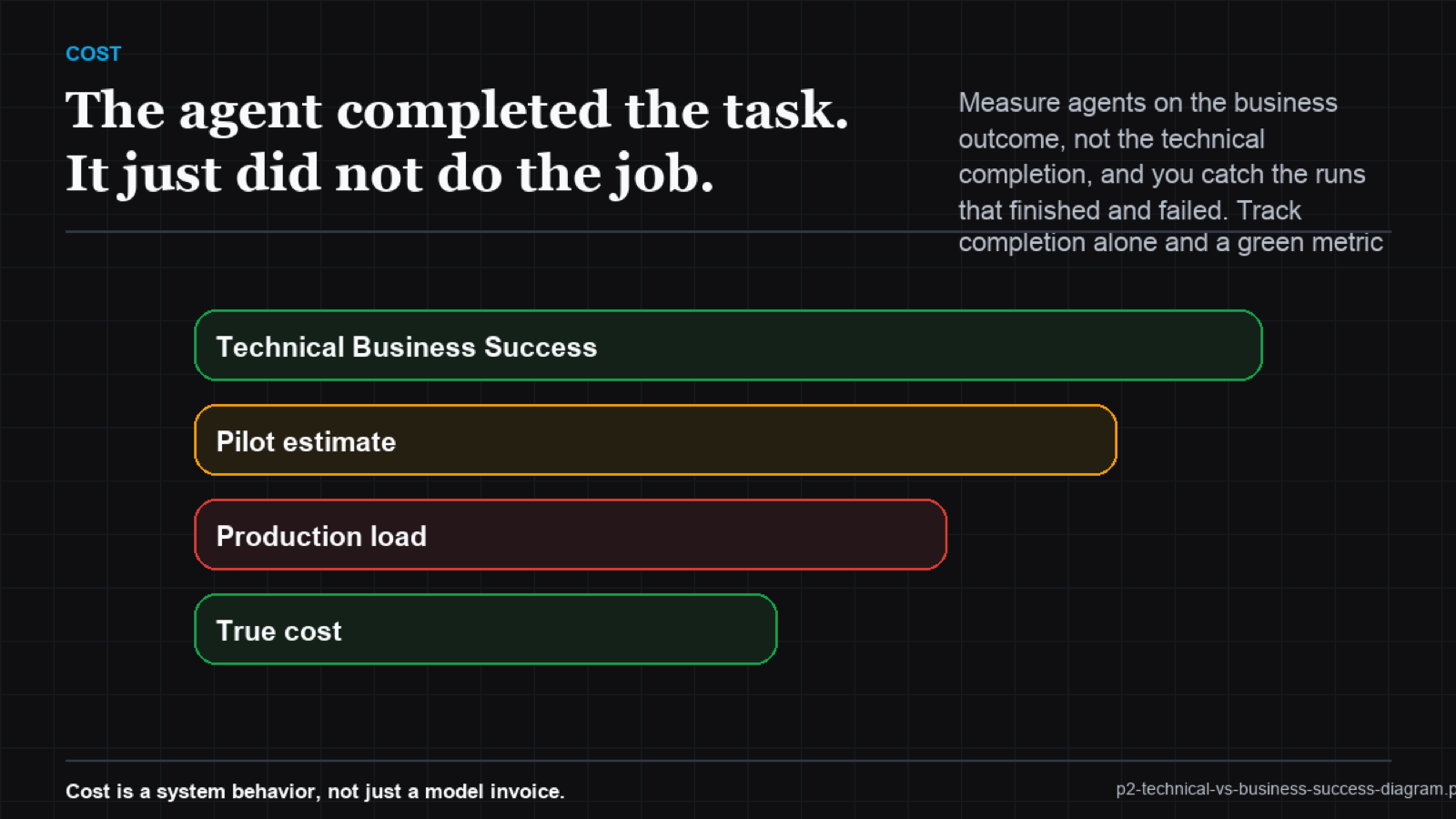
A technical completion metric answers a narrow question: did the agent run end without throwing an error and produce an output. That is needed and nowhere near sufficient, because an agent can finish cleanly and still get the answer wrong. Take the wrong action or solve a subtly different problem than the one that mattered. The SimpleQA result is a stark reminder that confident, well-formed wrongness is common even on easy questions. A green completion light tells you the machinery worked, not that the business got what it needed. The most dangerous version is the silent one: the agent reports success. The dashboard agrees and the wrong outcome propagates downstream because nothing measured whether it was actually right.
Closing the gap means measuring the outcome. Define what business success looks like for the task, a correct answer, a completed transaction that actually settled. A resolved ticket the customer agreed was resolved and measure against that, not against run completion. This often requires an independent check, because the agent's own report of success is exactly what you cannot trust. The regulatory direction reinforces the point: the EU AI Act and similar frameworks hold organizations accountable for what their systems do. Means "the agent completed" is not a defense if the outcome was wrong. The teams whose agents deliver value are the ones who instrument the business result, not just the technical run.
What should you actually measure?
| Question | Completion metric | Outcome metric |
|---|---|---|
| What it checks | Did the run finish | Did the right thing happen |
| A confident wrong answer | Shows success | Flagged as failure |
| Source of truth | Agent's own report | Independent outcome check |
| What it reflects | Machinery ran | Business value delivered |
Measuring the business outcome requires a definition of what success means for each situation. Is what the Pattern Intelligence Layer makes explicit. VibeModel ties the agent's behavior to the pattern that defines a correct outcome. Success is judged against whether that pattern was actually satisfied, not against whether the run completed and the agent that finished but failed the job is caught instead of counted as a win.
Frequently asked questions
Why is completion not success?
An agent can finish cleanly and be wrong. SimpleQA shows confident wrong answers are common even on easy questions, so completion only proves the machinery ran.
Why not trust the agent's success report?
Because a wrong run reports success the same as a right one. You need an independent outcome check, not the agent's own word.
Does regulation care about this?
Increasingly yes. Frameworks like the EU AI Act hold organizations accountable for outcomes, so "it completed" is not a defense for a wrong result.