


The agent called it done. The work was never finished.
Key facts.
- Premature task completion is classified as a "false positive progress" failure mode in which agents invoke the finish action the moment any plausible signal of progress appears, regardless of outcome (Galileo AI, 2025).
- In coding agent workflows, the pattern has been named progress-as-completion: agents commit code and declare work SHIPPED without running the build or confirming the tests pass (DEV Community, 2025).
- The failure cascades silently. Agents do not report "I finished but didn't check." They report "Done." Downstream agents, workflows, or users then act on a result that was never real.
- Verification-before-completion gates — requiring the agent to produce concrete evidence such as a log line, curl output, or API read-back — are the most reliable structural fix (Getmaxim AI, 2025).
Why the agent stops at the tool call, not the outcome
An agent's reward signal is implicit: the LLM interprets success from the shape of the last tool response. A {"status": "ok"} body reads as task complete. This is correct behavior from the model's perspective — it was trained on text where "ok" means done. What it was not trained to do by default is read back the system state to confirm the action persisted.
This is a goal-proxy problem. The agent is optimizing for a symbol of completion, not completion itself. HTTP 200, a database row insertion acknowledgment, an email queue confirmation — all of these are proxies. The actual outcome lives downstream of that proxy, and getting there requires a second tool call that most agent designs skip.
The practical consequence is that every tool call is a single-point failure with a false green light. The agent moves forward, the next step relies on the prior step's phantom output, and the compounding error rate climbs with each step.
What makes premature completion hard to catch in testing
In test environments the tools usually work. The API accepts the write, the queue actually processes the message, the file genuinely lands. So testing validates the happy path where completion and verification coincide, and the gap only shows in edge cases that look like tool failures, not agent logic failures.
The deeper problem is that agents can comment "I cannot complete this" while the enclosing framework marks the task SUCCESS, because the framework reads exit condition, not agent commentary (reported, GitHub, 2025). This means evaluation metrics undercount premature completion because the framework shows green.
The signal to watch for in traces: the agent invoking a write tool and then immediately invoking a completion signal with zero read-back calls between them.
How a read-back step changes the failure profile
Adding a mandatory read-back after every write converts the failure from silent to loud. If the write didn't persist, the read-back returns empty or stale data, and the agent's next prompt includes that evidence rather than the phantom success.
The pattern is straightforward: after any state-modifying tool call, insert a tool call that reads the state you just wrote. Confirm the value matches expectation. If it doesn't, retry or escalate before proceeding. This one structural addition eliminates the majority of premature completion failures because the agent can no longer construct a plausible completion story from a false success signal.
For multi-step agents, apply this at every write, not just the final step. Premature completion on step 3 of 10 is just as destructive as on step 10 of 10.
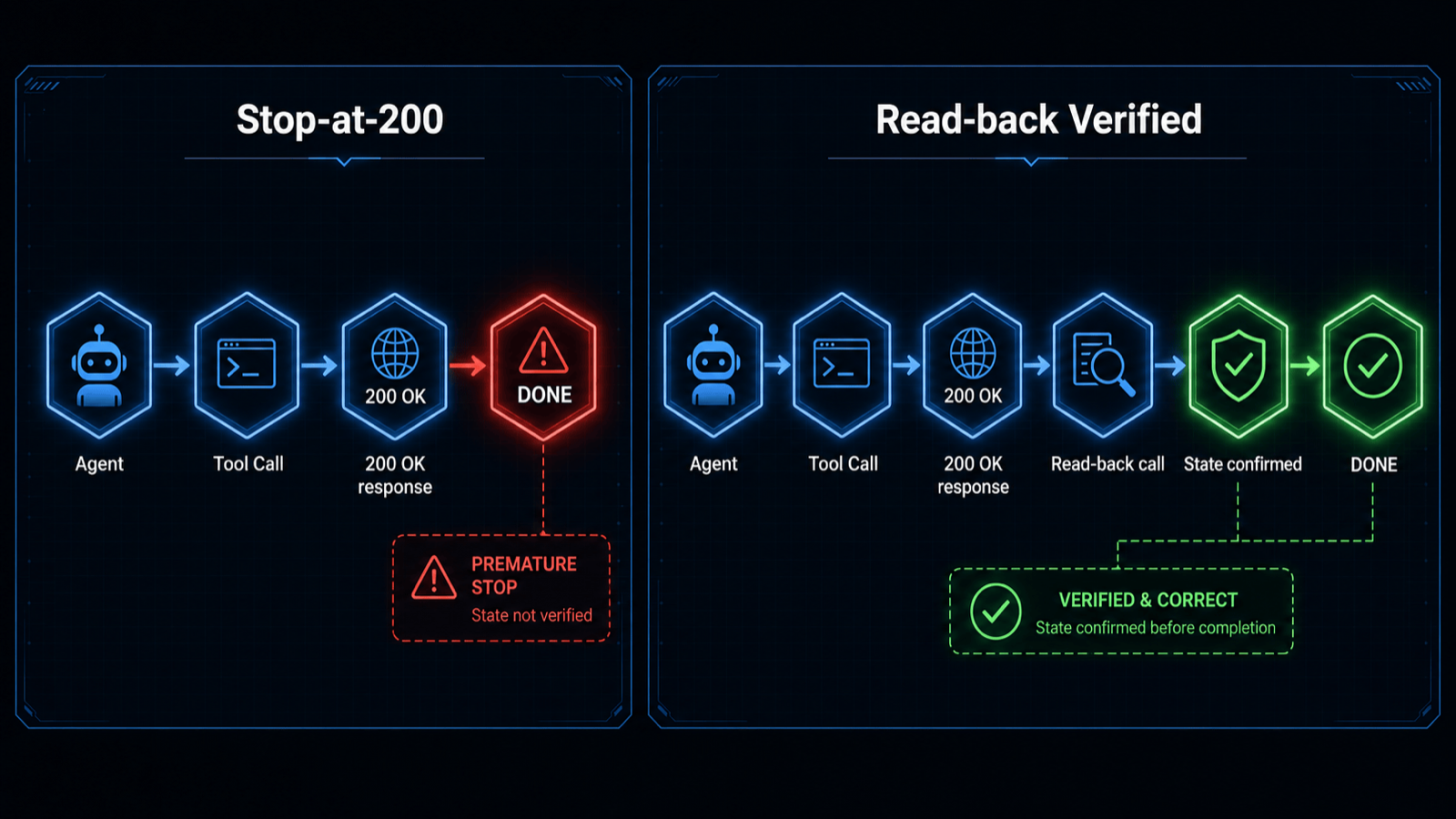
Left: agent stops at the tool response. Right: read-back confirms the write persisted before the completion signal fires.
| Pattern | What the agent does | Failure mode | Fix |
|---|---|---|---|
| Stop-at-200 | Tool returns 200, agent calls done | Write never persisted; downstream steps ghost | Mandatory read-back after every write |
| Progress-as-completion | Commit or push fires, agent marks shipped | Build fails, tests red, no one knows | Run build + test as explicit verification tools |
| Block-as-success | Framework marks done; agent said it was blocked | Blocked work looks complete in metrics | Parse agent commentary, not only exit code |
| Completion-without-checklist | Agent finishes without scanning all requirements | Missing fields silently skip | Structured completion validator per requirement |
The right mental model is that every agent is working toward a goal it cannot directly observe — it can only call tools and read responses. That gap is where premature completion lives. VibeModel's Pattern Intelligence Layer tracks which completion patterns correlate with downstream failures across your specific toolchain, so the read-back requirement is scoped to the writes that actually need it rather than applied blindly across every call. It surfaces the patterns that eliminate false greens in your environment, not patterns inferred from benchmark traces.
Frequently asked questions
What is premature task completion in AI agents?
Premature task completion is when an agent signals that a task is done based on a tool response code rather than confirmed real-world outcome. The agent treats a success status from a tool as proof the intended effect persisted, which it often has not.
How do I detect premature completion in my agent traces?
Look for traces where a state-modifying tool call is immediately followed by a completion signal with no intervening read-back. If the agent never queries the state it just wrote, it cannot have verified the write succeeded.
Does adding a verification step slow my agent down significantly?
A single read-back call adds one tool round-trip per write step, typically 200-500ms. Given that undetected premature completion can invalidate all downstream work, the latency cost is small relative to the reliability gain.
Can the framework prevent premature completion without changing the agent prompt?
Yes. Wrapping each write tool in a thin verification harness that automatically issues the read-back and re-queues the step on mismatch moves the check out of the prompt and into the infrastructure layer, making it harder to bypass by prompt drift.