


Key facts.
- NIST AI Risk Management Framework: structured approach for governing AI risk, the foundation for the layered controls safety-critical deployments actually need.source
- Constitutional Classifiers: even strong single defenses keep residual bypass paths. Safety-critical work needs multiple independent controls, not one strong one.source
Why does safety-critical change the bar?
Rare failures in low-stakes settings are annoying. You fix them and move on. In safety-critical or high-availability environments, the same rare failure means harm, SLA breach or a regulatory event. So the engineering bar shifts: you're no longer optimizing for the average case, you're engineering for the worst case and its probability. A control that catches 99% of bad outputs is fine for a marketing assistant. It's not fine for an agent touching patient data or financial settlement. That 1% miss is exactly the case that matters. Constitutional Classifiers demonstrates why single defenses aren't enough: even a strong defense has residual bypass. In safety-critical work, you cannot accept a single point of failure with residual exposure.
The answer is defense in depth, what aviation, nuclear and medical device engineering have used on non-AI systems for decades. Multiple independent controls so one failure gets caught by another. Formal risk assessment to identify high-consequence failure modes specifically, not just generally hope against them. Redundancy and graceful degradation so the agent failing doesn't pull the service down. NIST AI RMF structures exactly this. Higher bar is not bureaucracy. It's matching control rigor to consequence severity.
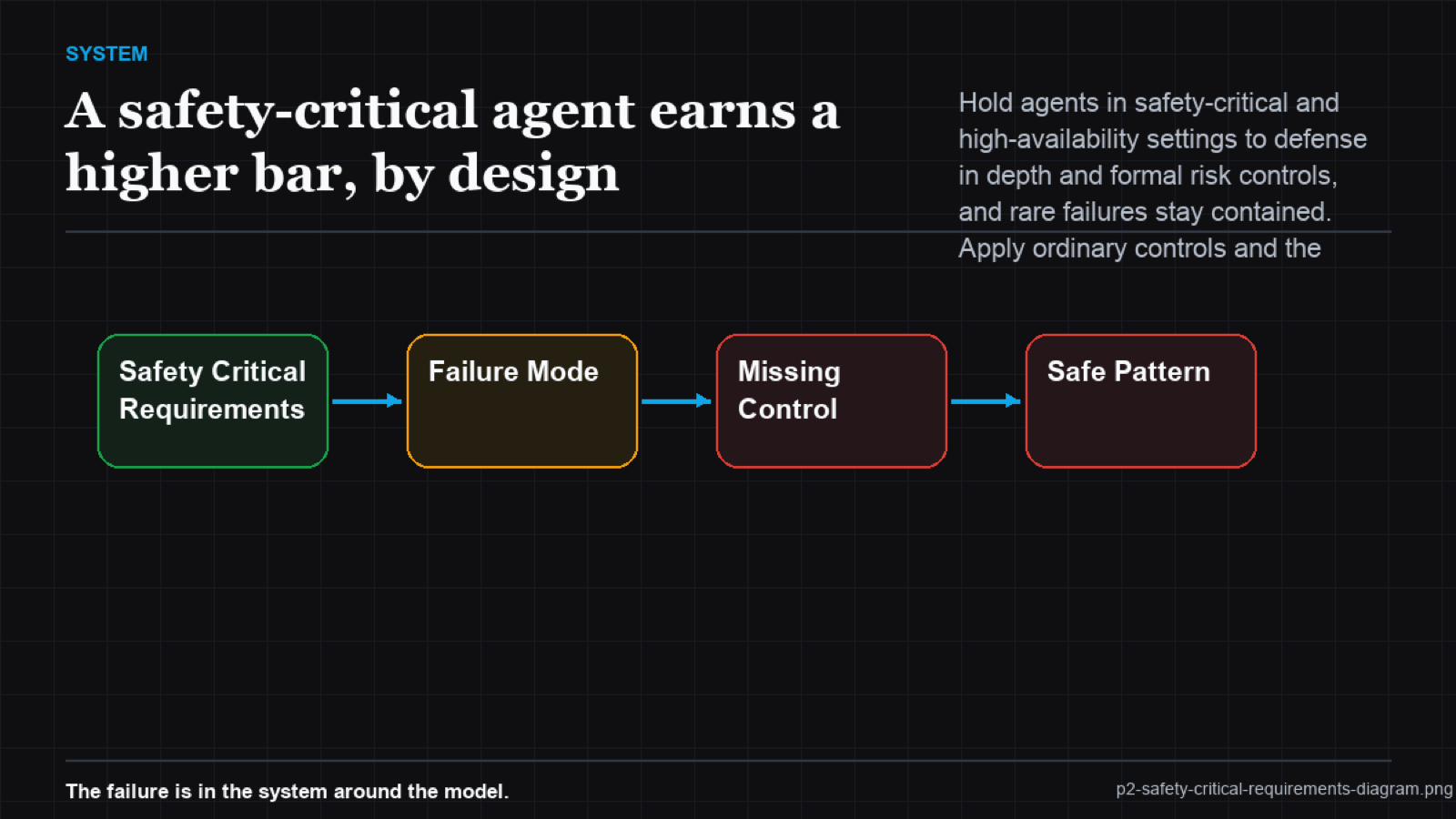
What does the higher bar require?
| Control | General-purpose | Safety-critical |
|---|---|---|
| Defenses | Single control | Defense in depth |
| Risk approach | Best effort | Formal risk management |
| Availability | Best effort | Redundancy, degradation |
| The rare failure | Tolerated | Specifically mitigated |
Applying defense in depth well means knowing which situations carry the highest consequence so the layers concentrate there, which is what the Pattern Intelligence Layer makes explicit. VibeModel surfaces the high-stakes patterns, so safety-critical controls are layered exactly where a failure would be catastrophic and the agent meets the higher bar by design rather than by hoping the rare case never arrives.
Frequently asked questions
Is a more capable model enough for a safety-critical bar?
One strong safeguard still leaks, the bypass Constitutional Classifiers measures; a more capable model makes that rare leak cost more, late. (arXiv:2501.18837)
Why is a 99% control not enough here?
Because the 1% it misses is the high-consequence case. Safety-critical settings engineer for the worst case and its probability, not the average.
What is defense in depth?
Multiple independent controls so a failure in one is caught by another, since even strong single defenses have residual bypass.
Do frameworks like NIST AI RMF help?
Yes. They structure the identification and mitigation of high-consequence risks rather than leaving reliability to a single launch test.