


Key facts.
- OpenTelemetry's GenAI semantic conventions define agent spans (for example invoke_agent), tool-call spans, and attributes for reasoning, including reasoning-token usage, so the decision chain becomes structured telemetry.source
- For an agent, each LLM call, retrieval, and tool call becomes a child span, producing a full trace of the reasoning chain rather than a single request line.source
- LangSmith (from the LangChain team) treats traces of full agent runs, including intermediate reasoning steps and tool calls, as foundational to production observability.source
- Arize Phoenix, open source and built on OpenTelemetry/OpenInference, visualizes every step (prompts, tool calls, reasoning paths) to make agent decision-making a "glass box."source
Why don't the existing pillars cover this?
Metrics and logs miss the reasoning behind each move, and a stronger model raises the need, since tau-bench shows a frontier agent repeating a task a quarter of eight tries, so the retry needs it. (source)
Each classic pillar answers a question that isn't the one an agent failure asks. Metrics tell you how often something happens. Logs tell you what happened. Traces tell you the path a request took across services. All three were designed for systems whose behavior is fixed by code. An agent's behavior is decided at runtime by a model reasoning over inputs, and none of the three pillars records that reasoning. So when an agent calls the wrong tool or returns a confidently wrong answer, the metrics stay healthy, the logs show the action, and the trace shows the path, while the one thing you need (why the agent chose that) is nowhere in the telemetry.
That gap is why teams keep saying their dashboards were green while the agent failed. The failure lived in the reasoning, and the reasoning was never an observable surface. Adding it isn't cosmetic. it's the difference between reading a root cause off the trace and guessing at it from effects.
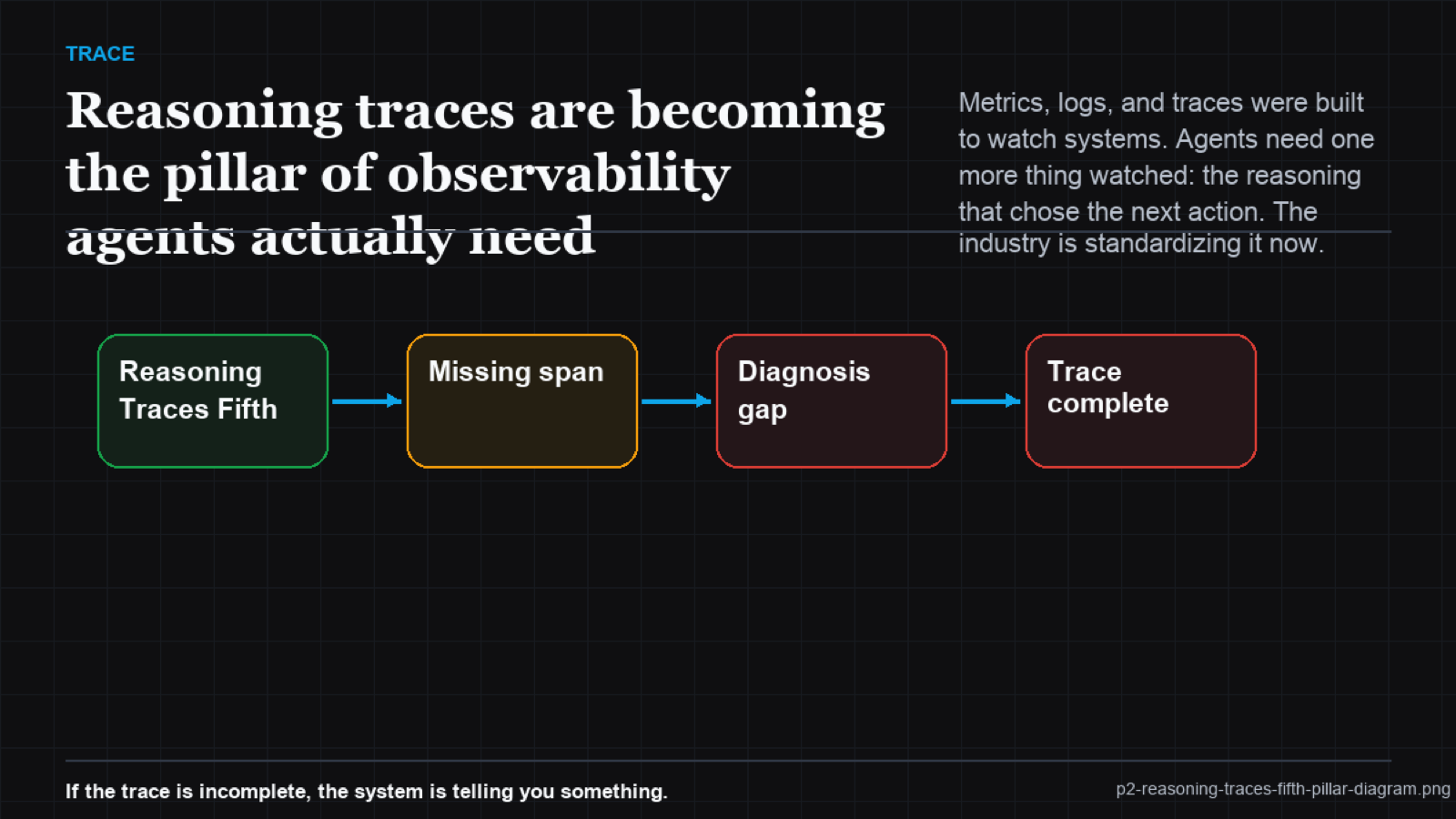
What does instrumenting the reasoning pillar actually involve?
Capture the agent's decision chain as structured spans: the plan, the candidate tools, the chosen tool and its arguments, the tool response, the next decision, and the reasoning tokens that connect them. OpenTelemetry's GenAI conventions give you a vendor-neutral schema for this, so the reasoning trace plugs into the monitoring stack you already run instead of becoming a proprietary silo. LangSmith and Phoenix already emit and visualize these traces, including the intermediate steps, so you can replay an agent run and watch it weigh options, pick the wrong one, and act, with the input that pushed it there in plain view.
| Pillar | Question it answers | Covers agent reasoning? |
|---|---|---|
| Metrics | How often? | No |
| Logs | What happened? | No |
| Traces | What path across services? | Partly, not the why |
| Events | What discrete thing occurred? | No |
| Reasoning traces | Why this decision? | Yes, by design |
this is the surface a Pattern Intelligence Layer is built to watch. Reliability at the pattern level means the reasoning behind every decision is captured and replayable as a property of how the agent runs, so root cause is something you read, not reconstruct. The classic four pillars still earn their place for system health. The reasoning pillar is the one that makes a non-deterministic agent debuggable, and it stays useful no matter which model you run underneath.
Frequently asked questions
Is "fifth pillar" an official term?
Not yet. Sources more often call it agent spans, trajectories, or reasoning traces, framed as an extension of traces. The label is emerging, but the standardized telemetry behind it's real and shipping.
Do I have to adopt a proprietary tool?
No. OpenTelemetry's GenAI conventions are vendor-neutral, and tools like Phoenix are open source. The reasoning trace stays portable across your existing stack.
Why does non-determinism make this urgent?
Identical inputs can yield different decisions, so you often can't reproduce a failure on demand. The recorded reasoning trace of the actual run is your reliable path to root cause.