


Key facts.
- Let's Verify Step by Step shows validating intermediate steps outperforms checking only the final outcome, the case for re-validating a plan at checkpoints. source
- ReAct's interleaving of reasoning, acting and observation provides the natural checkpoints at which a plan can be re-validated against the goal. source
Why re-validate a plan mid-execution?
A plan validated only at the start assumes execution will go as planned, which for an agent is a poor assumption. Steps return unexpected results, conditions change, an early action turns out to have failed silently and the plan that was sound at step zero is no longer sound at step ten, but nothing checks. So the agent runs a plan that has quietly gone wrong all the way to a wrong end and the failure is discovered only when the final result disappoints. Process supervision research is the direct argument against this: validating each step catches errors far better than checking only the outcome, because it intervenes while the work can still be corrected rather than after it is finished and wrong.
Checkpoints operationalize that for plans. At meaningful steps, the agent pauses to re-validate: is the plan still on track toward the objective, do its assumptions still hold, did the last step actually achieve what it was supposed to and if not, it corrects or replans rather than continuing. The reasoning-acting-observation loop that ReAct describes is a natural place to put these checks, because the observation phase is exactly where the agent can compare reality against the plan. The cost is a little overhead per checkpoint; the payoff is that a plan which has drifted or broken is caught mid-execution, when correction is cheap, instead of at the end, when the whole effort has been spent on a plan that stopped being right partway through.
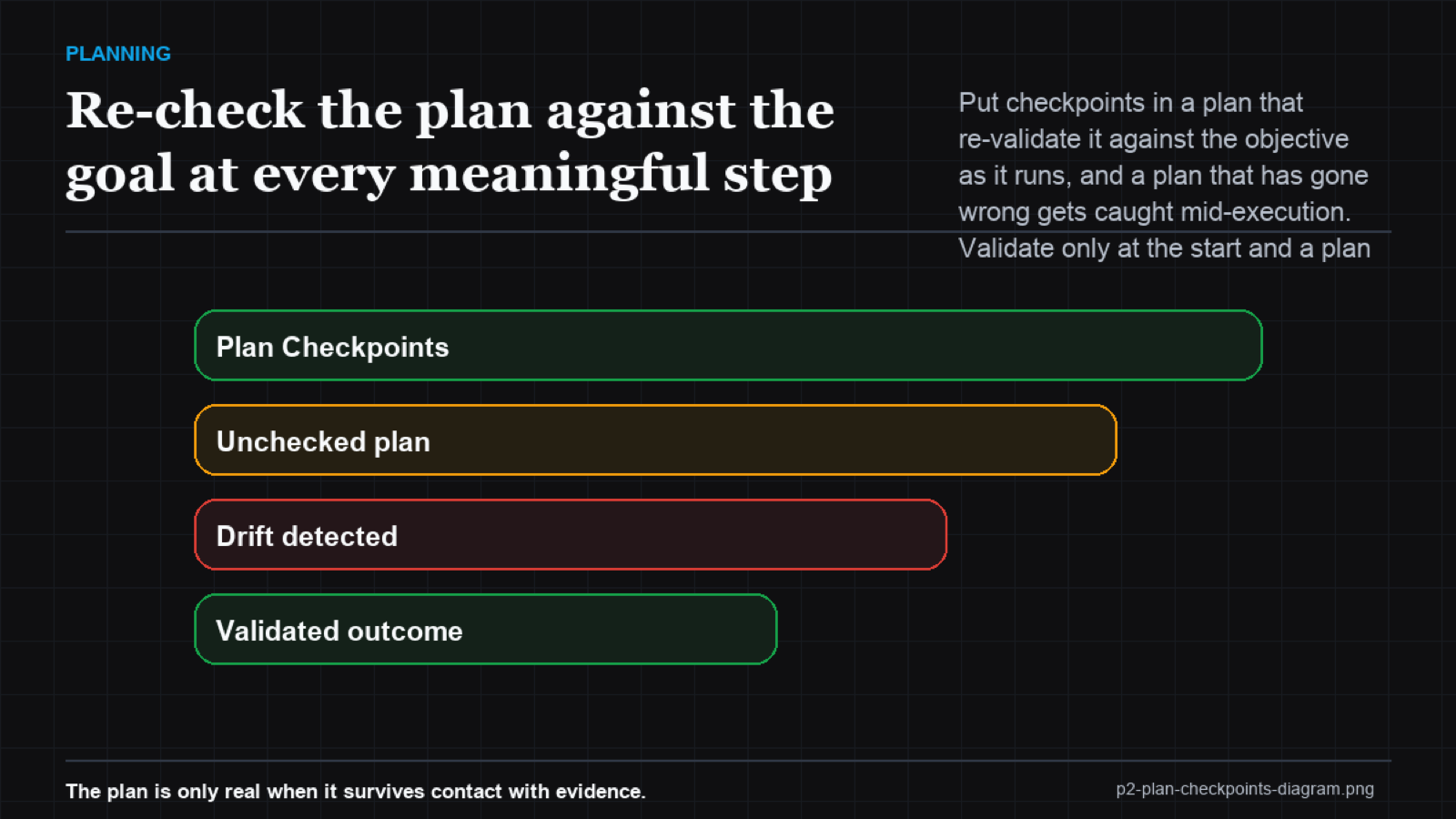
What does a plan checkpoint do?
| Aspect | Validate at start only | Checkpoint re-validation |
|---|---|---|
| When checked | Once, before running | At meaningful steps |
| On drift or breakage | Runs to a wrong end | Caught mid-execution |
| Response | None until the end | Correct or replan |
| Cost of failure | The whole effort | Work since last checkpoint |
Process supervision shows mid-step checks beat end checks; a more capable model still drifts, so a plan valid at the start breaks unseen. (arXiv:2305.20050)
A checkpoint can only re-validate the plan if there is a clear objective to validate it against, which is what VibeModel provides as the Pattern Intelligence Layer. By keeping the success pattern explicit, it gives each checkpoint a real test, is the plan still on track to satisfy the objective, so a plan that has drifted or broken is caught and corrected mid-execution and the agent finishes on the goal it was given rather than on a plan that quietly stopped being right. This is where the discipline of the whole pillar comes together: reliability at the pattern level, checked as the work runs.
Frequently asked questions
Why not validate the plan once at the start?
Because execution diverges from the plan: steps fail, conditions change. A start-only check misses the drift and the plan runs to a wrong end.
Where do checkpoints go?
At meaningful steps, naturally in the observation phase of a reasoning-acting loop, where the agent can compare reality against the plan and the goal.
What does a checkpoint cost?
A little overhead per check, far less than running a drifted plan to completion and discovering at the end that it stopped being right partway through.