

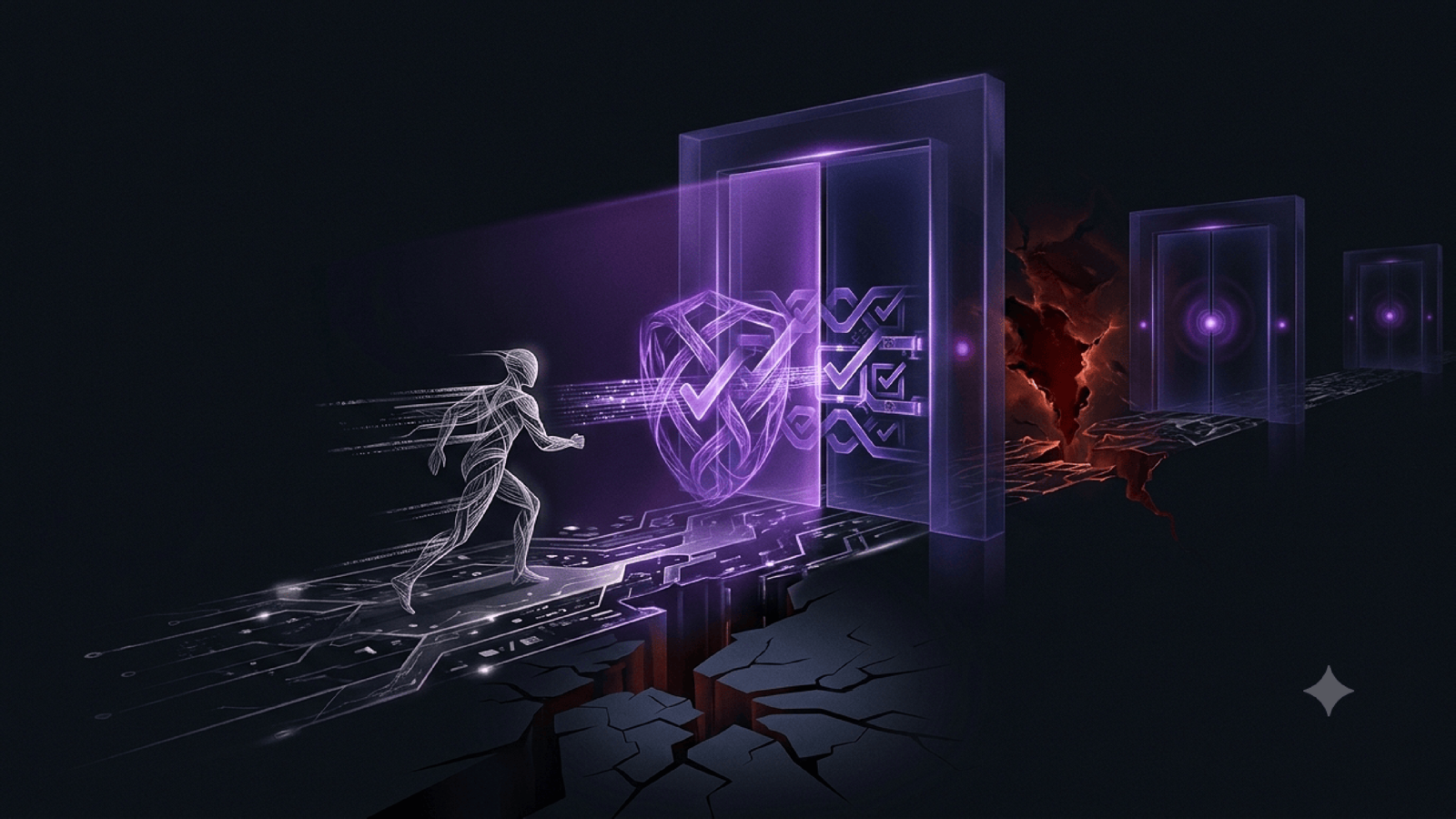
Key facts.
- METR (arXiv:2503.14499) found that agents with phase-transition validation checkpoints outperform agents with end-to-end execution particularly on tasks exceeding 30 steps, where early-phase errors without detection compound across subsequent phases (METR, arXiv:2503.14499).
- Airline crew resource management protocols use "challenge and response" checkpoints at every phase transition (taxi, takeoff, cruise, descent, approach, landing) as a verified model for catching errors before they compound - a design pattern directly applicable to multi-phase agent workflows.
- OSWorld (arXiv:2404.07972) task analysis shows that when agents are evaluated with partial-task assessment (was each phase correct?), error rates in phase 1 of 4 predict failure in the remaining phases with high accuracy, validating the value of phase-1 exit gates.
- Execution gate design for agent workflows requires three elements: a phase completion condition (what does "phase 1 done" look like in measurable terms?), a progress metric (how far toward the goal is the current state?), and an escalation path (what happens if the gate check fails?).
- The latency cost of an execution gate is proportional to the verification complexity: a simple state check adds milliseconds; an LLM evaluation of goal progress adds 200-500ms. For long-running tasks, this overhead is negligible relative to the time saved by catching early errors.
What an execution gate actually is
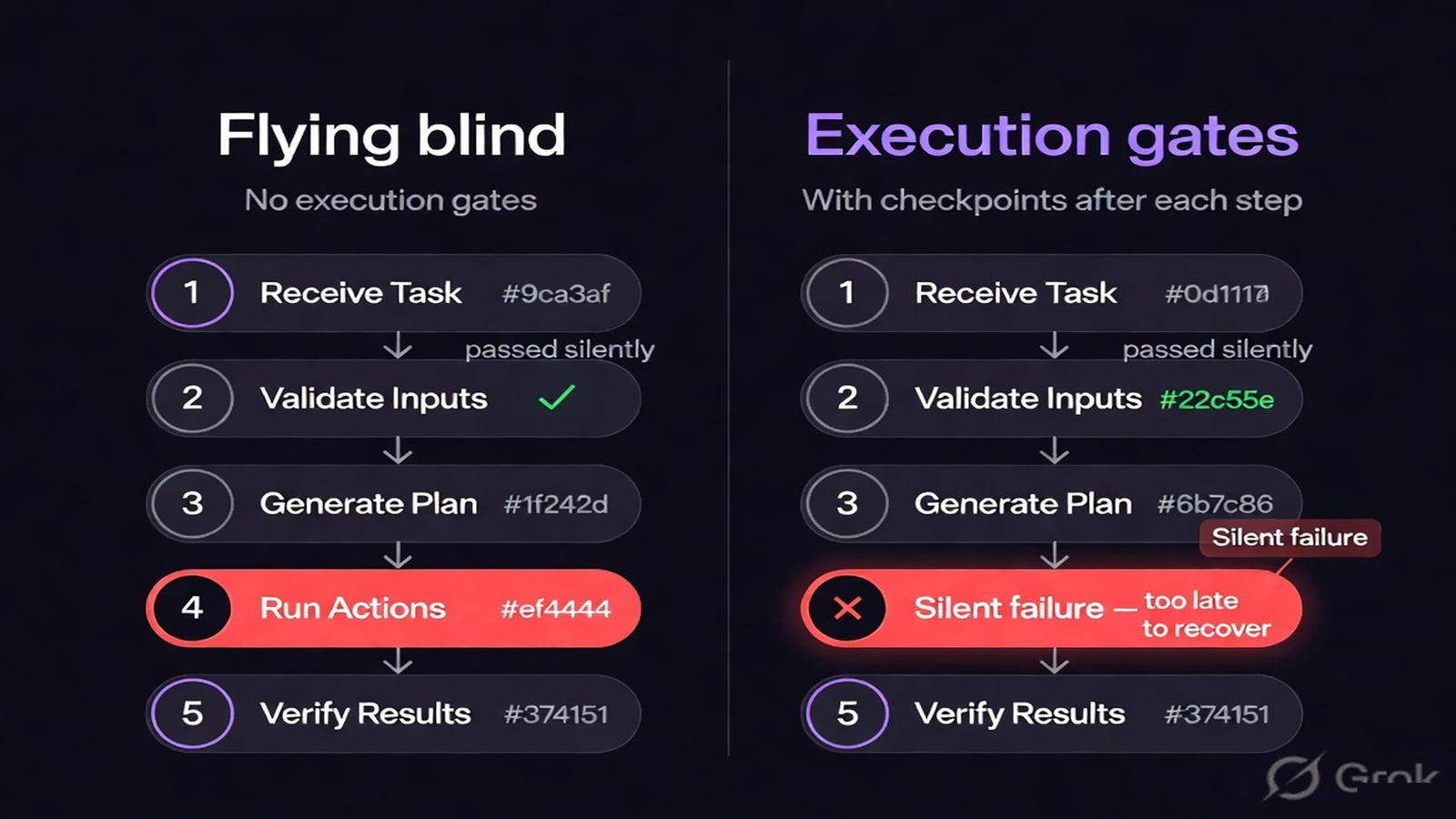
An execution gate is a checkpoint between workflow phases that must pass before the next phase begins. The gate checks three things: did the previous phase complete correctly (verifying that what was supposed to happen did happen), is the current state on track toward the overall goal (verifying that the cumulative effect of all phases so far is pointing the right direction), and are the prerequisites for the next phase present (verifying that the next phase has what it needs to succeed). If any of these checks fails, the gate triggers an escalation path rather than allowing the workflow to continue.
The escalation path options are: retry the failed phase, alert a human operator, degrade to a reduced-scope completion, or halt the workflow with a clean error state. Which path is triggered depends on the failure type and the workflow context. what's never the correct escalation is "silently proceed to the next phase anyway" - which is what an agent without execution gates does by default.
Designing execution gates for multi-phase workflows
The gate design process starts with identifying the phase transitions in the workflow - the points where one distinct category of action ends and another begins. Data gathering ends where analysis begins. Analysis ends where action begins. Action ends where verification begins. Each transition is a candidate gate location. For each gate, define the completion condition in measurable terms, the acceptable range for the progress metric, and the escalation options. The gate implementation is then a deterministic check at each transition point, not an additional LLM call in most cases.
Execution gate requirements by workflow phase type
| Phase transition | Completion condition to check | Progress metric | Typical escalation |
|---|---|---|---|
| Data gathering to analysis | Required data sources retrieved and validated | Data completeness vs minimum threshold | Retry missing sources, then alert |
| Analysis to action | Analysis output meets confidence threshold | Confidence score vs minimum | Human review if below threshold |
| Action to verification | All intended actions completed | Actions completed vs plan count | Retry failed actions, then halt |
| Verification to close | All checks passed | Check pass rate vs 100% | Alert on any fail, human review |
VibeModel's Pattern Intelligence Layer identifies where in your specific workflow phase transitions the execution gate failures most often occur. By analyzing the patterns that precede gate failures, it tells you which completion conditions are most likely to be false positives, which progress metrics need tighter thresholds, and which phase transitions carry the highest risk of passing incorrectly. That makes gate design a data-driven engineering task rather than an architectural guess.
Frequently asked questions
Won't a more capable model need fewer checkpoints?
Checkpointed agents beat end-to-end runs in METR as tasks grow; a stronger model still wastes the run when no gate validates progress. (arXiv:2503.14499)
How many execution gates are too many?
A gate at every significant phase transition is appropriate. A gate at every individual step is overhead that doesn't provide proportionate benefit - step-level checks are better implemented as assertions within the step implementation, not as full gates. The rule of thumb: one gate per phase transition, typically 3-5 per complex workflow.
What if the agent's workflow doesn't have clear phase transitions?
Impose them. Most workflows that appear to lack clear phases actually have latent phase structure: information gathering, reasoning, action-taking, verification. Making that structure explicit is the prerequisite to adding gates. If you can't identify the phase structure, the workflow is likely too undifferentiated to be reliable regardless of gates.
Can execution gates be added retroactively to an existing agent deployment?
Yes, and often this is where the highest-value gates are. Instrument your existing agent's workflow to log phase transition points, then add gate checks as a middleware layer that intercepts the transition. The existing agent's logic doesn't need to change; the gate is external to it.