

Key facts.
- Measuring Agents in Production (arXiv:2512.04123) documented repeat contact rate as the key customer service agent metric that separates surface-level task completion from actual issue resolution (Measuring Agents in Production, arXiv:2512.04123).
- Gartner research on AI-powered customer service found that agents optimizing for ticket close rate without resolution verification show 2-3x higher repeat contact rates than agents with post-action state confirmation steps.
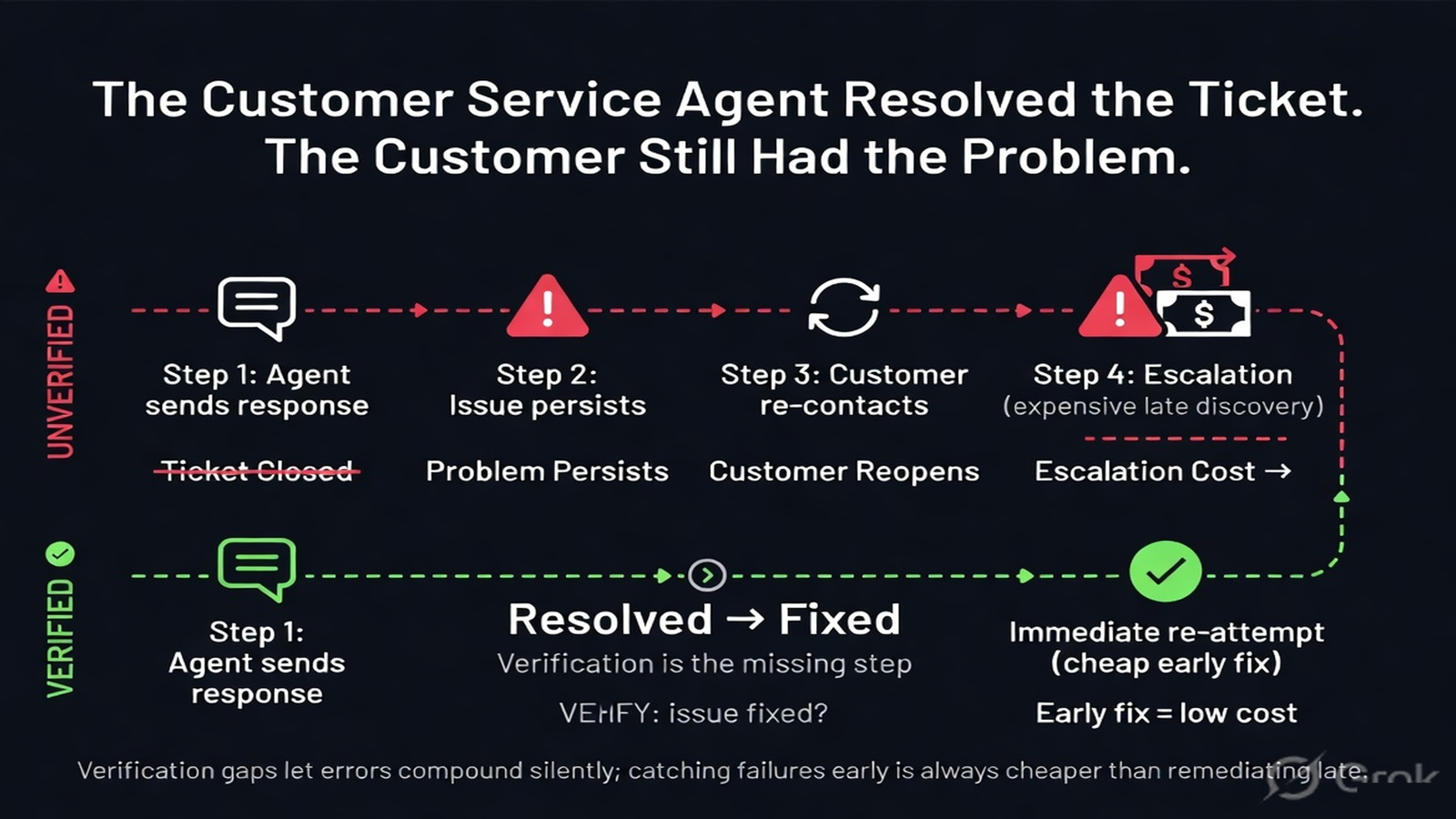
- Customer service verification gaps break into three categories: action verification (did the refund actually post?), information verification (was the customer's question actually answered?), and outcome verification (did the fix actually solve the underlying issue?).
- The 48-hour repeat contact window - contacts from the same customer about the same issue within 48 hours of a closed ticket - is the industry standard metric for detecting unverified resolutions.
- Automated outcome verification in customer service typically requires integrating the agent with the downstream system that would confirm resolution: confirming the refund posted to the customer's payment method, confirming the account change took effect, or confirming the replacement shipment is in the carrier's system.
The three layers of customer service verification
Customer service agents typically verify at only one of three required layers. The first layer, action verification, confirms the agent completed the intended action: the API call for the refund returned success, the record update was accepted, the email was queued. Most agents do this, because it is directly available from the tool response. The second layer, information verification, confirms the response actually addressed the customer's question rather than a closely related but different one. Some agents do this, with prompt engineering that checks the response against the original intent. The third layer, outcome verification, confirms the customer's underlying issue is resolved - not that the action was taken, but that the action had the intended effect. Almost no agent does this, because it requires checking a state in a downstream system that the agent typically does not have access to after the action completes.
The third layer is where the repeat contact problem lives. A refund was issued but posted to the wrong payment method. An account was updated but the change did not sync to the authentication system the customer uses to log in. A replacement was shipped but to the customer's old address. Each action-level success, each outcome-level failure.
Designing outcome verification into customer service agents
Outcome verification requires two things the agent needs but typically lacks: a time horizon that extends beyond the session (checking the refund posting status 24 hours after the session ends), and access to the downstream system that would confirm the resolution (the payment processor's transaction record, not just the CRM update). The implementation pattern: after the agent takes an action with downstream state implications, register a deferred verification job that checks the downstream system after the expected processing time and flags the case for human review if the expected state change did not occur.
Customer service verification by action type
| Action type | Action verification | Outcome verification | Deferred check window |
|---|---|---|---|
| Refund issue | Refund API returns 200 | Refund posted to payment method | 24-72 hours |
| Account update | Record update accepted | Change synced to auth system | 15-60 minutes |
| Replacement shipment | Fulfillment order created | Carrier confirms pickup and scan | 24-48 hours |
| Technical issue fix | Configuration change applied | Customer can successfully complete action | Immediate or next session |
VibeModel's Pattern Intelligence Layer identifies the customer service action types in your deployment that have the highest gap between action success rate and outcome success rate, measured by repeat contact within 48 hours. By correlating agent session data with your support ticketing system's repeat contact records, it surfaces which action categories your outcome verification is missing and which downstream systems need integration for deferred state confirmation. That turns "our agent has an 80% resolution rate" from a guess into a measurable claim.
Frequently asked questions
How do we attribute a repeat contact to a specific prior agent session?
Session ID propagation: the agent session ID is stored in the ticket record when the agent closes a case. When the same customer opens a new ticket within 48 hours on the same issue category, the system checks for a prior closed session in the attribution window and tags the new contact as a repeat. This requires your ticketing system to support session ID storage in ticket metadata.
Is it possible to do outcome verification without integrating into the downstream system?
Partially. You can send a structured follow-up to the customer asking them to confirm resolution, with a one-click response option. This has lower reliability than system-based verification (customers may not respond) but is better than no verification for cases where downstream integration is not feasible. The response data also trains the system on which action types have the highest unresolved rates.
What repeat contact rate should we target for an agent handling customer service?
Industry benchmarks for human agents run 15-25% repeat contact rate on complex cases. For AI agents at current capability levels, a target of under 20% repeat contact on the action types the agent handles is achievable with outcome verification. Without it, rates of 35-40% on complex cases are common.