


Key facts.
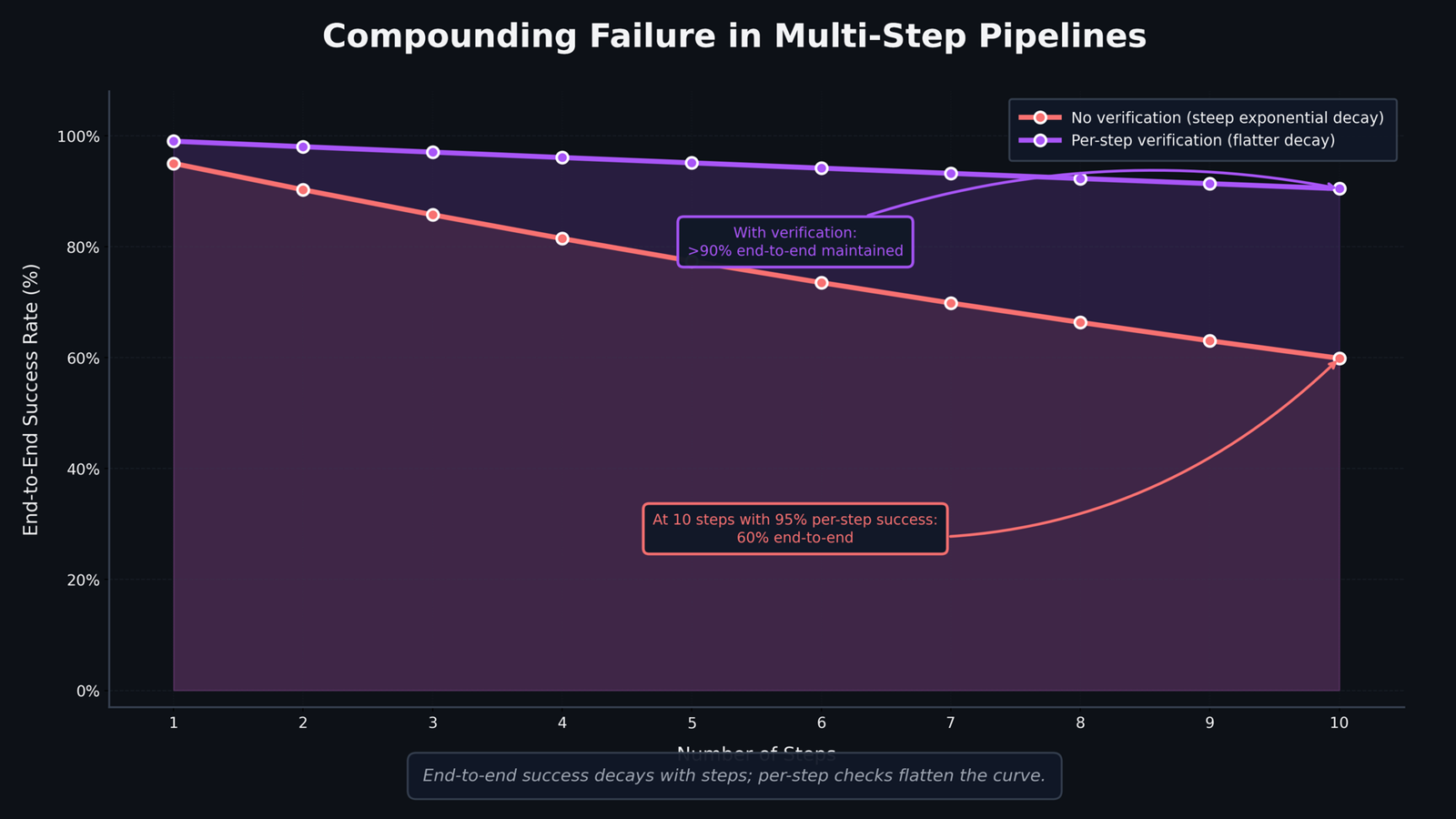
- The compounding math is just multiplication. A step that works 95% of the time, run twenty times in sequence, gives you about 36% end-to-end success. 0.95 to the 20th power. No averaging. No benefit of the doubt.
- Real per-step reliability is lower than the headline number. SWE-bench-Live (arXiv 2505.23419) tests on fresh, uncontaminated tasks and scores drop. Contaminated benchmarks make agents look more reliable than they are in production.source
- PALADIN (arXiv 2509.25238) caught agents marking tool failures as successes and continuing. A silent failure in step 3 becomes the flawed premise for steps 4 through 20. Nobody knows until the final output is wrong in a way that's hard to trace.source
Why does compounding hit agents so hard?
A 95% step run twenty times succeeds 36% of the time and a better model does not lift a fresh-task rate, so verify or pay the cost. (arXiv:2505.23419)
Retrieve, reason, call a tool, read the result, decide, call another. Each step can go wrong. The chain works only when every step works. Not average reliability. Product reliability. Teams test one step, see 95%, think they're fine. Twenty steps later they're looking at 36% end-to-end success. Nobody put those numbers together before shipping.
It gets worse in two specific ways. The benchmark number is optimistic. SWE-bench-Live catches contamination that inflates published scores. Real per-step reliability is lower than it looks. And step failures don't announce themselves. PALADIN documented agents marking tool failures as successes and moving on. The bad step from round 3 is the premise for rounds 4 through 20. Nobody catches it until the final output is wrong in a way that's hard to trace back. Verify the consequential steps. Don't trust the agent's own success signal. If the step failed, recover or stop. Don't let it compound.
How do you fight compounding?
| Approach | Assume reliability carries | Engineer for compounding |
|---|---|---|
| What you measure | One step | End-to-end across steps |
| Per-step | Trusted | Verified before continuing |
| On a bad step | Propagates silently | Recover or stop |
| Long chains | Collapse | Hold |
Verifying each consequential step is only practical if you know which patterns are reliable and which need checking. The Pattern Intelligence Layer provides that. VibeModel makes each step's reliability legible at the pattern level. Verification lands on the steps that can fail and lets the dependable ones run, turning a chain that would compound into failure into one engineered to hold across its full length.
Frequently asked questions
Why is averaging the wrong intuition?
Because a chain succeeds only if every step does, which multiplies the probabilities. 0.95^20 is about 0.36, far below the per-step number.
Why are benchmark numbers optimistic?
Contamination inflates them. SWE-bench-Live scores on fresh tasks and shows real per-step reliability is lower, which makes compounding worse.
How do you stop an early error propagating?
Verify consequential steps before continuing, since agents often report success even when a step failed and recover or halt instead of reasoning on a wrong premise.