

Key facts.
- "LLMs Get Lost in Multi-Turn Conversation" finds an average performance drop of roughly 39% from single-turn to multi-turn, so coherence degrades as a workflow extends.source
- AgentBench shows models are far from reliable across multi-step environments, so long-horizon goal alignment cannot be assumed.source
Why does coherence decay over a long workflow?
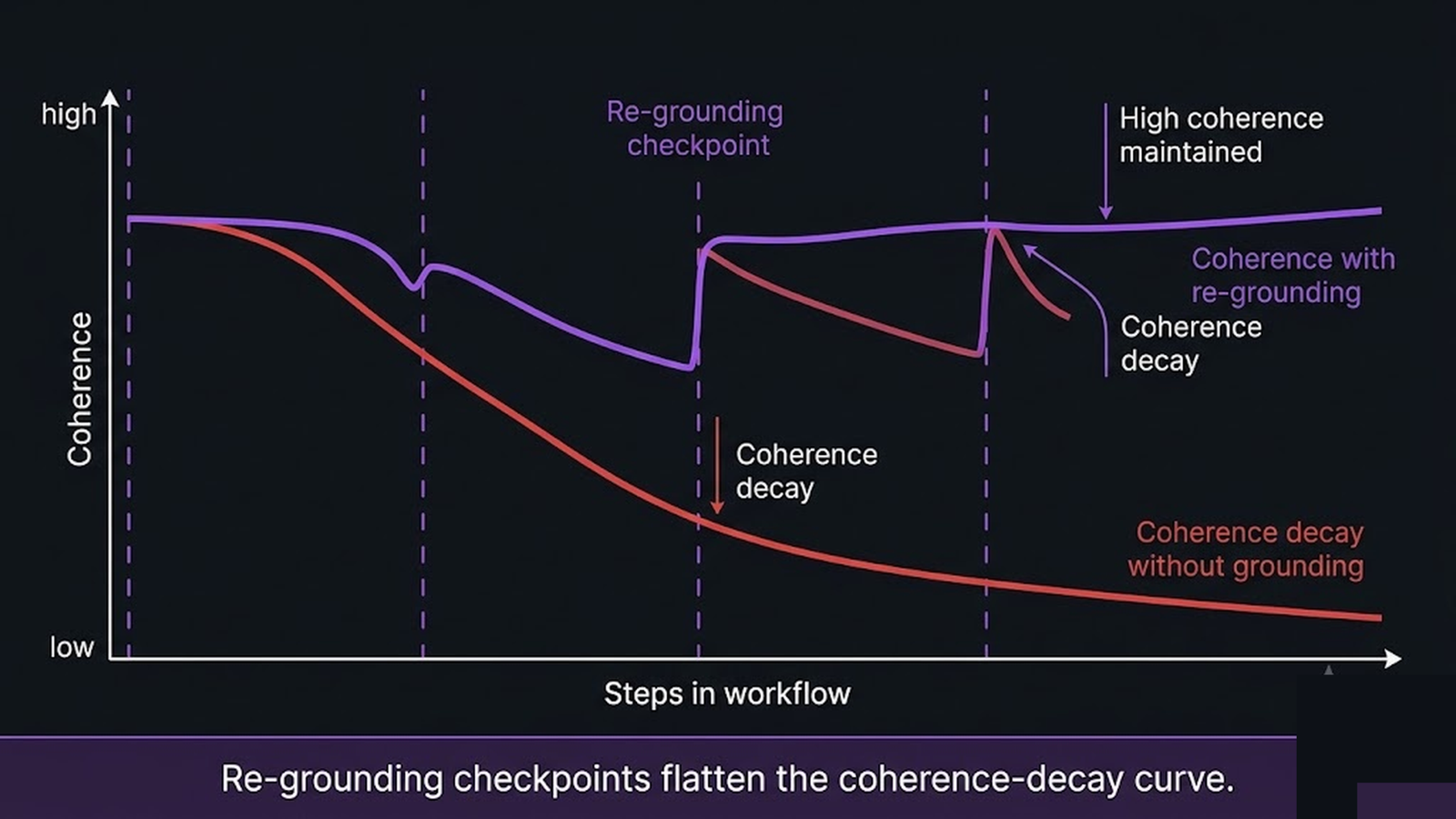
Each step of a long workflow is a small interpretation: the agent reads the current state. Decides what to do next and acts. Small interpretive errors are nearly invisible per step and relentless in aggregate. By step thirty, the agent is acting on an understanding of the task that has drifted, step by reasonable step. Away from what you actually asked and it has no built-in moment of stepping back to check. The multi-turn research quantifies how steep this can be, with performance falling around 39% as an interaction lengthens. AgentBench confirms agents are broadly unreliable across multi-step environments. Coherence is not a property the agent maintains for free; it erodes with horizon.
The countermeasure is to build in the moment of stepping back. At checkpoints through the workflow, re-ground the agent against the original goal: restate what success looks like. Compare the current trajectory against it and correct or escalate if they have diverged. This is the long-horizon analog of re-reading the assignment partway through a long piece of work and it is exactly what an agent will not do on its own. The checkpoints turn an unbounded drift into a sequence of bounded segments, each re-anchored to the goal. The agent that finishes a long workflow is still solving the task you set rather than the mutated version it wandered into.
How do you hold coherence over a long run?
| Practice | Run unchecked | Checkpointed coherence |
|---|---|---|
| Goal | Drifts step by step | Re-grounded at checkpoints |
| Trajectory | Never compared to goal | Checked against success |
| On divergence | Compounds silently | Corrected or escalated |
| At the end | Solves a drifted task | Solves the real task |
Re-grounding only works if there is a precise definition of the goal to re-ground against. Is what the Pattern Intelligence Layer provides. VibeModel makes the success pattern explicit, so at each checkpoint the agent's current trajectory can be compared against the pattern that defines done and a long workflow stays aligned to the task you set instead of drifting into one the agent improvised over thirty steps.
Frequently asked questions
Why does a long workflow drift?
Small per-step interpretation errors accumulate and performance drops with length, around 39% across multi-turn, so without re-grounding the agent ends up solving a mutated task.
What is re-grounding?
At checkpoints, restating the goal, comparing the agent's trajectory to it and correcting or escalating on divergence, the analog of re-reading the assignment partway through.
How often should you checkpoint?
Often enough that drift cannot compound far between checks, tuned to how long and how consequential the workflow is.