


Key facts.
- DORA (EU 2022/2554) requires financial entities to identify, log and manage ICT risk continuously from the start, the regulated version of governing the work from day one not bolting it on.source
- MIT NANDA's "State of AI in Business 2025" tied measurable impact to disciplined teams, evidence that the habits a team starts early are what later turn a pilot into value (reported).source
- BCG's 2025 research found the companies generating AI value at scale are the ones that went beyond tool deployment to disciplined integration, evidence that early discipline is what positions a team to operate agents at scale.source
Why not wait for a governance platform?
Because waiting means the first experiments run with no governance at all and by the time the platform arrives the agent may already be doing something that matters, with months of behavior nobody recorded. Governance is not a switch you flip at production. It is a set of habits that are far cheaper to start small than to retrofit. The team that names an owner, logs decisions and writes down boundaries in week one is not slowing the experiment down. It is building the record and the discipline that the production gate will later demand. The team that defers all of it discovers at the gate that it has a working agent and no answers to the questions governance was supposed to have been collecting all along.
BCG's value-gap research is why even an early experiment is worth governing. The companies that capture value are the disciplined ones. That happens because a prototype already drifts, loops and fails in instructive ways and those failures are the raw material for the boundaries and checks you will need later. A more capable model lengthens the leash but does not remove the drift. The early failures keep coming and keep being worth recording. Starting governance light, an owner, a log, a boundary list, a failure review, costs almost nothing and compounds: each habit is the seed of a production control. When the experiment graduates, the governance graduates with it instead of being invented under pressure.
What are the four habits to start with?
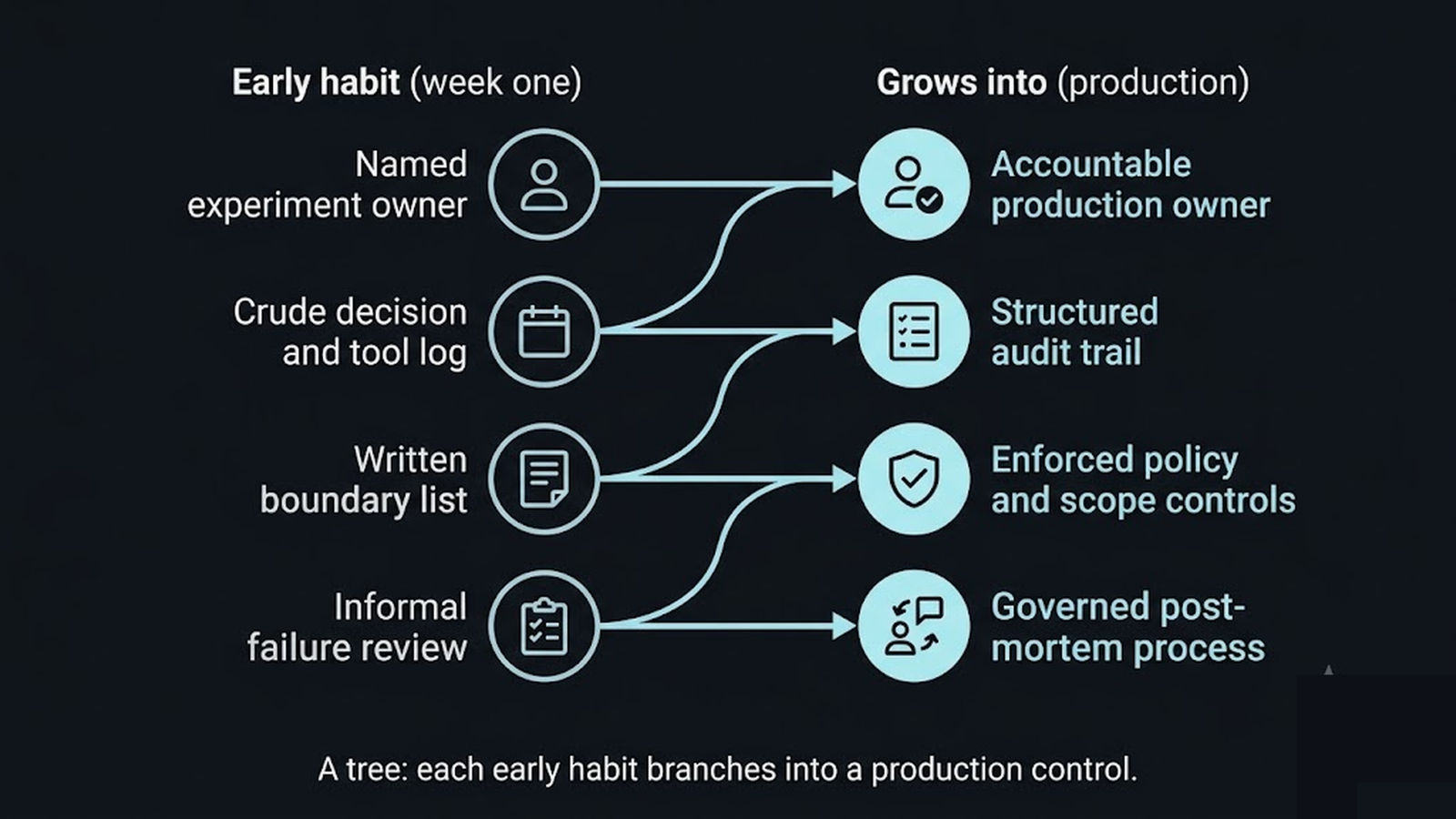
An owner: one named person responsible for the experiment's agent, so accountability exists from the start. A log: capture the agent's decisions and tool calls, even crudely, so you can see what it actually did. A boundary list: write down what the agent may and may not do, so scope is explicit and reviewable. A failure review: If the agent does something wrong, look at why and note it. The experiment teaches you something. None of these need a platform. All of them scale: the owner becomes the production owner, the log becomes the audit trail. The boundary list becomes enforced policy, the review becomes the post-mortem process. Start them light and they are already the right shape If the agent grows up.
| Early habit (week one) | Grows into (production) |
|---|---|
| Named experiment owner | Accountable production owner |
| Crude decision and tool log | Structured audit trail |
| Written boundary list | Enforced policy and scope controls |
| Informal failure review | Governed post-mortem process |
The Pattern Intelligence Layer is where the early habits and the production controls are the same thing at different depths. Governance grows continuously from the first experiment instead of being rebuilt at the gate. Ownership, logging, boundaries and review are tracked at the pattern level from day one. Is what lets a light start scale without a discontinuity. Reliability at the pattern level is something you begin building in week one, not at launch.
Frequently asked questions
Isn't governance overkill for an experiment?
Heavy governance is. Four light habits, owner, log, boundary list, review, cost almost nothing and are the seeds of the controls you will need anyway.
Why start before there's a platform?
Because waiting means months of ungoverned behavior nobody recorded. The habits are far cheaper to start small than to retrofit at the production gate.
Do these habits actually scale?
Yes. The owner becomes the production owner, the log becomes the audit trail, the boundary list becomes policy, the review becomes the post-mortem. Same shape, more depth.