

Most models fail to revise a conclusion after contradicting evidence, and grow more confident instead.Shown information that contradicts its initial answer, an LLM tends to dig in rather than update (When Two LLMs Debate, Both Think They'll Win, arXiv:2505.19184, 2025). So when a tool returns a result that proves your agent's plan wrong, it often ignores it.

Key facts.
- Most models fail to revise an initial conclusion after receiving contradicting information, and can grow more confident instead, a basic belief-updating limitation (When Two LLMs Debate, Both Think They'll Win, arXiv:2505.19184, 2025).
- When context conflicts with the model's priors, faithfulness drops: a study measured a notable decline in how well models follow provided context once it contradicts what they already believe (FaithfulRAG, arXiv:2506.08938, 2025).
- Two recurring modes appear in knowledge conflict, context-ignoring (clinging to priors) and context-overfitting (derailing on new input), and both persist across prompting and fine-tuning (Can LLMs Reconcile Knowledge Conflicts in Counterfactual Reasoning?, arXiv:2506.15732, 2025).
Why does the agent cling to a stale plan?
Because it has no separate, updatable model of what's true, only a running narrative that favors coherence. Once it has committed to a plan, the plan is the strongest thing in its context, so a contradicting tool result reads as noise to be explained away rather than evidence to act on. This shows up as agents repeating a failed action instead of revising it, and as confident non-updating when fresh evidence contradicts the plan. The same coherence pressure also drives the opposite error: faced with a confident-looking but noisy result, the agent can over-update and derail, throwing away a valid prior plan. Neither behavior is reconciliation. The agent is picking whichever signal is loudest in its context, not weighing them.
Why is reconciliation the missing piece?
Because resolving a conflict needs information the agent doesn't track by default: where each fact came from, how recent it's, and how much to trust it. Without provenance and confidence, the agent can't reason that a fresh tool reading should override a cached assumption, or that a single anomalous value shouldn't overturn a well-supported plan. Research on context conflict shows the failure directly: when provided context contradicts the model's internal beliefs, its faithfulness to that context measurably drops, so it quietly reverts to its prior rather than reconciling (FaithfulRAG). The agent isn't stubborn or gullible by design. It simply has no structured step that says: compare these claims, by source and recency, and decide.
How do you make the agent reconcile?
Give it an explicit world model and a reconcile step. Store facts as beliefs with provenance, timestamps, and confidence, separate from the plan, so new tool output updates a tracked belief rather than competing as loose text. Add a dedicated step that compares the current plan against new evidence and decides: revise the plan, keep it, or flag uncertainty, instead of letting coherence pick. Require multi-source agreement before overturning a high-confidence belief, so one noisy result can't derail the run, and surface genuine contradictions for a conservative default or a human when stakes are high. Use reflection that explicitly names the conflict. The agent then updates on real evidence and holds steady against noise, because it's weighing sources rather than following the loudest sentence.
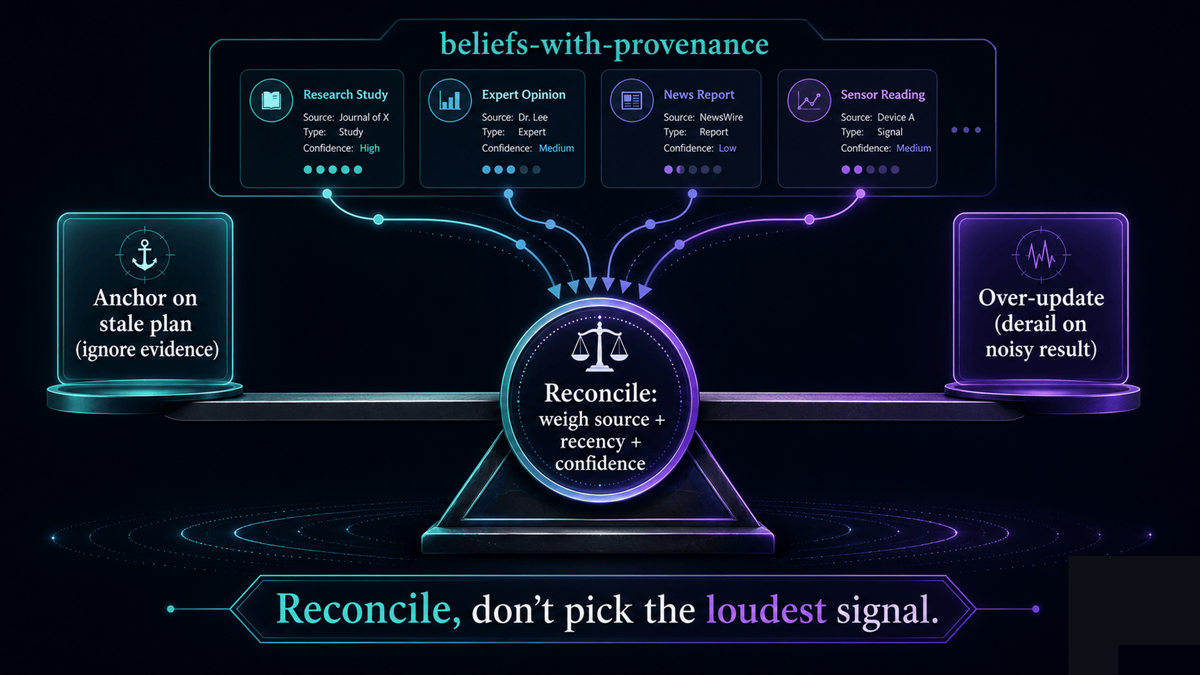
The two failure modes and the fix
| Behavior | What it looks like | Fix |
|---|---|---|
| Anchor on stale plan | Ignores contradicting evidence | Reconcile step that can revise the plan |
| Over-trust new output | Derails on a noisy result | Require multi-source agreement to overturn |
| No provenance | Cannot weigh sources | Beliefs with source, timestamp, confidence |
| Coherence wins | Loudest signal decides | Explicit conflict comparison |
| High-stakes conflict | Confident wrong action | Conservative default or human escalation |
The pattern is that an agent with no provenance and no reconcile step resolves a plan-versus-evidence conflict by coherence, so it either ignores the result that proves it wrong or derails on a noisy one. Track beliefs with source and confidence, add an explicit reconciliation step, and require agreement before overturning a strong prior, and the agent updates for the right reasons. Building that structured conflict handling, rather than trusting the model to weigh evidence in its head, is reliability at the pattern level, which is what VibeModel builds as the Pattern Intelligence Layer.
Frequently asked questions
Why does the agent trust its plan over fresh data?
Because the plan is the dominant thing in its context and it optimizes for coherence, so contradicting evidence reads as noise. Separate beliefs from the plan and add a reconcile step so new evidence updates a tracked fact instead of competing as text.
How do I stop it derailing on one weird result?
Require multi-source agreement before overturning a high-confidence belief, so a single anomalous tool output can't discard a well-supported plan. Reserve full updates for evidence that's corroborated.
What does provenance actually buy me?
It lets the agent weigh sources: a fresh, trusted reading can override a stale assumption, while a low-confidence one can't. Without source, recency, and confidence, there's nothing to reconcile with.