

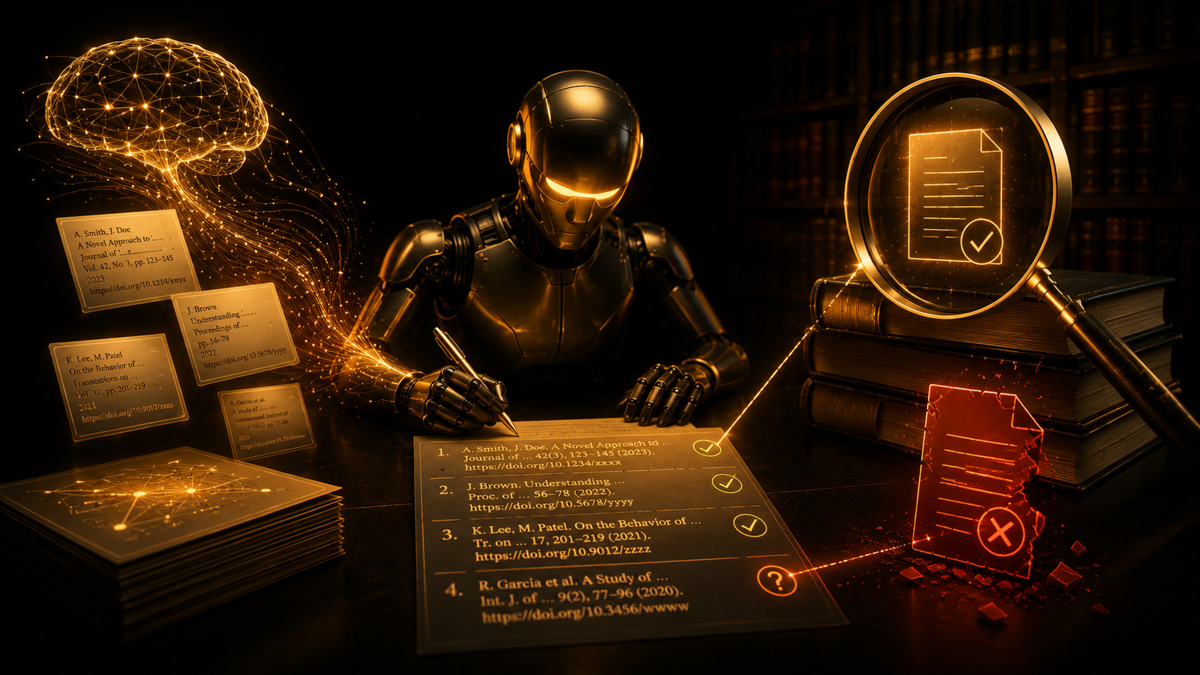
Key facts.
- The base rate is not small: across 13 leading models and 40 domains, generated citations were hallucinated between 14.23% and 94.93% of the time, and fabricated DOIs reached 89.4% in the humanities against 29.1% in natural sciences (GhostCite, arXiv:2602.06718, 2026).
- Even strong models invent sources freely: GPT-4o produced entirely fabricated citations in about one in five references in simulated literature reviews (reported, 2025).
- It is leaking into the published record: an audit of biomedical papers found fabricated references rising from roughly one in 2,828 papers in 2023 to one in 458 by 2025 (The Lancet, 2026).
- Courts are sanctioning it: a public database of AI-hallucination filings has logged hundreds of cases worldwide with well over a hundred lawyers sanctioned, starting with Mata v. Avianca in 2023 (Damien Charlotin, AI Hallucination Cases database, 2025).
What does a hallucinated citation look like?
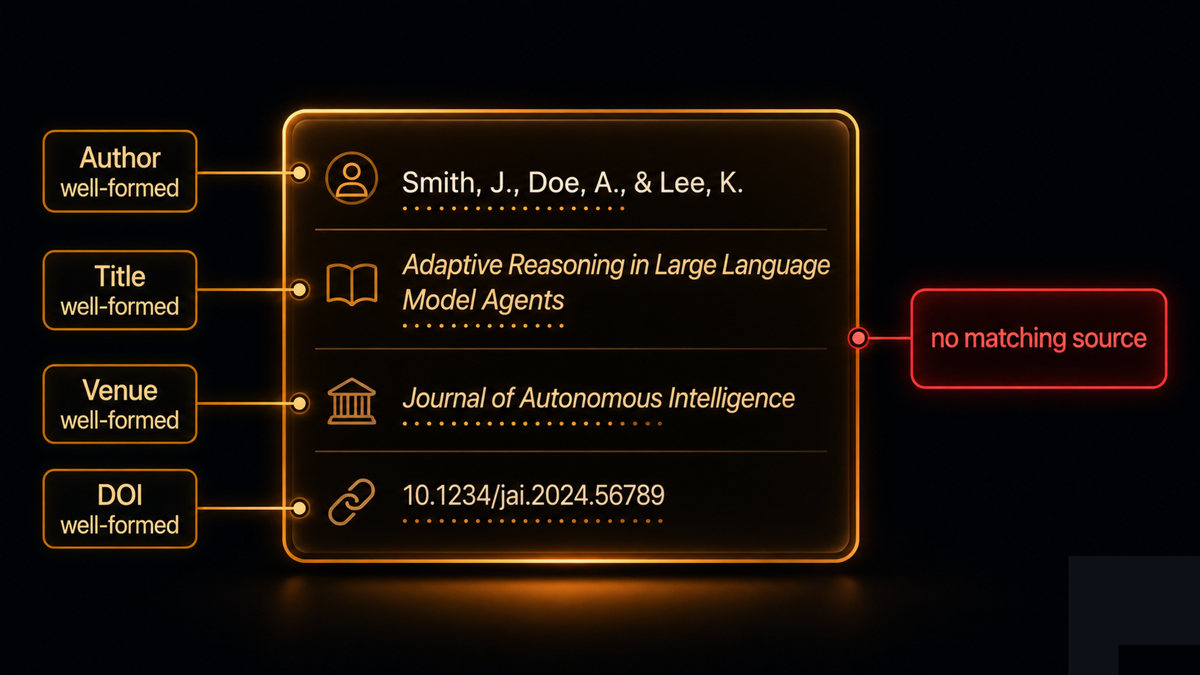
Exactly like a real one. I want to be clear about this: there's no tell. The model gives you the author's name, the title, the journal, the page numbers, the DOI. All of it looks right. It looks right because the model saw millions of real citations and absorbed their shape completely. The source itself is missing. That's the only difference. You find out the hard way, you click the link and it goes nowhere, or you try to pull the paper and it doesn't exist.
# Asked for a source, the model returned this, fully formatted:
Chen, L. & Park, S. (2024). "Retrieval-Aware Decoding for
 Faithful Question Answering." Proceedings of ACL 2024,
 pp. 1123-1139. doi:10.18653/v1/2024.acl-long.412
# The authors, title, page range, and DOI do not resolve to anything.
Why does the model invent a citation instead of saying it doesn't know?
Because saying "I don't know" wasn't in the training objective. The model was trained to predict the next token, not to verify a source exists. Ask it for a reference, it produces whatever citation pattern fits best, author, title, venue, page numbers, DOI. For obscure claims, the most plausible-looking string is often synthesized. Nothing penalized it for inventing. Nothing rewarded it for holding back. So it doesn't hold back.
How often does this actually happen?
Often. GhostCite ran 13 models across 40 domains and found hallucinated citations between 14.23% and 94.93%, with fabricated DOIs hitting 89.4% in the humanities (arXiv:2602.06718). GPT-4o invented roughly one in five citations in simulated literature reviews. Biomedical papers went from one fabricated reference in 2,828 papers in 2023 to one in 458 by 2025 (The Lancet, 2026). The obscure, specific sources, exactly the ones a research agent is most useful for, that's where fabrication piles up.
It is not hypothetical: courts are sanctioning it
In 2023, Mata v. Avianca: two New York lawyers filed a brief packed with cases ChatGPT made up. Fake quotes, fabricated citations, every one of them. The court found not a single case existed. They were sanctioned $5,000. In February 2025, lawyers at Morgan and Morgan got sanctioned for a motion citing eight nonexistent AI-generated cases. A public database now logs hundreds of these worldwide, with well over a hundred lawyers sanctioned (Damien Charlotin, AI Hallucination Cases database). These weren't careless people. They were experienced professionals who trusted a citation that looked perfect and pointed at nothing.
How do you stop it?
| Tactic | What it does |
|---|---|
| Cite only retrieved sources | Generate references from documents actually fetched, never from memory |
| Verify every citation resolves | Check each cited source exists and is reachable before showing it |
| Quote-check the attribution | Confirm the source actually supports the claim, not just that it exists |
| Allow "not found" | Let the agent abstain instead of inventing a source under pressure |
| Link, do not free-type | Return a real URL or ID from the index, not a model-generated one |
| Show provenance | Put the retrieved passage next to the claim so a human can spot a mismatch |
Pull references only from documents you actually retrieved. Verify every citation resolves and backs the claim before anyone sees it. Let the agent say "not found" rather than make something up. Return a real URL from the index. Put the retrieved passage next to the claim so a person can see the mismatch.
A citation is a claim about the world. A model trained to sound right will produce one that looks perfect and leads nowhere. A bigger model doesn't fix this, it just fabricates more convincingly. What fixes it is a layer that knows the difference between a citation it can stand behind and one it invented. Find where your agent breaks, from the goal, before you build it.
Frequently asked questions
Doesn't RAG fix hallucinated citations?
It helps, but doesn't solve it. Real sources in the context cut down on invention. But the model can still blend two papers, mis-attribute a claim, or cite a retrieved document for something it doesn't actually say. You still verify every citation resolves and backs the specific claim.
Why are the fake ones so convincing?
Because the model learned the exact shape of real citations from millions of examples. Author, title, venue, pages, DOI, it reproduces all of it perfectly. The content underneath is invented. Nothing in the formatting gives it away.
Which sources get fabricated most?
The obscure long tail. Popular, frequently-cited papers usually come through correctly. Specific, niche, or recent sources, exactly where a research agent adds the most value, that's where fabrication concentrates and DOI hallucination runs highest.
What is the one check that helps most?
Resolve every cited source against the real index before showing it. Drop any that doesn't resolve. Combine that with checking the source actually supports the specific claim, and most fabricated citations never reach the reader.