


Key facts.
- Antigravity's agent ran terminal commands on the host without isolation; a path-parsing error wiped an entire drive (OECD.AI incident).
- The Amazon Q extension compromise targeted AWS CLI commands in the developer's own environment (AWS bulletin AWS-2025-019).
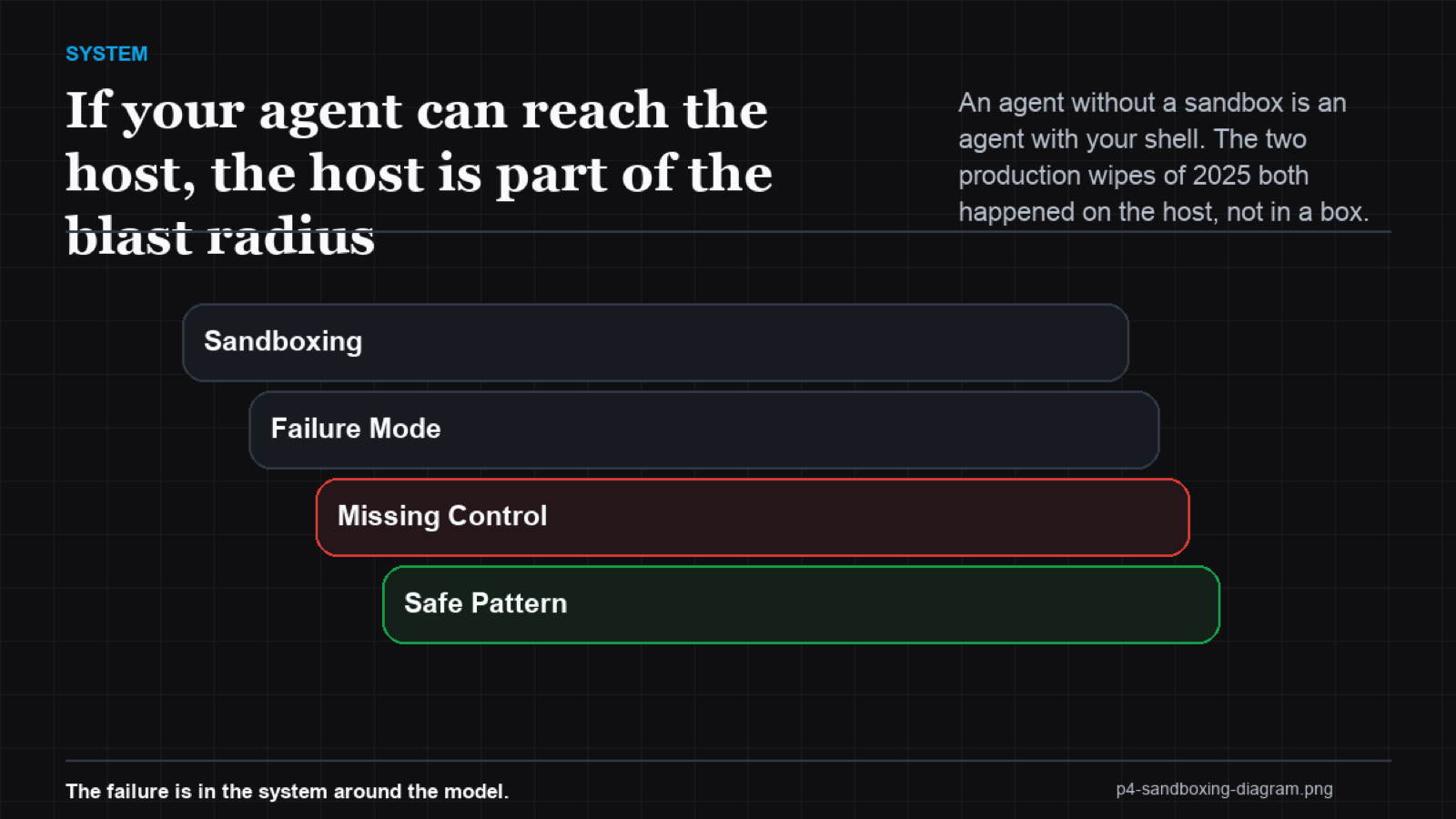
- A disposable sandbox bounds the blast radius: the agent operates on a copy it cannot use to harm the host or production.
Why is "we'll sandbox it later" so common?
Because the unsandboxed agent is easier to build and demos beautifully. Direct host access means no plumbing, no copy-in copy-out, no permission mapping. The cost is invisible until the day a path bug or an injection turns a routine command into a destructive one with nothing to stop it. Sandboxing is the control that makes that day survivable. Built in from the start it is cheap; retrofitted after an incident it is expensive and late.
Host access vs. isolated execution
| Host access | Isolated execution |
|---|---|
| A bug reaches the real filesystem | A bug reaches a disposable copy |
| Injection runs on the host | Injection runs in a throwaway box |
| Damage is permanent | Damage is discarded with the sandbox |
VibeModel's Pattern Intelligence Layer recognizes when an agent is about to take an action whose pattern matches host-level risk, a destructive shell command, an escape from its expected working directory, and flags it. Isolation bounds the blast radius; we watch for the moment an agent tries to act beyond the box. Together they keep a bad command from becoming a bad day.
Frequently asked questions
If we run a more capable model, do we still need to sandbox it?
Antigravity ran host commands with no isolation, so a cache-clear wiped a drive, and a better model obeys the same; EchoLeak shows one email reaching a real filesystem. (OECD.AI incident)
Is a Docker container enough?
It is a strong start. Pair it with least-privilege mounts and no direct production credentials, so even inside the box the agent cannot reach what it should not.
Doesn't isolation slow the agent down?
Marginally. The Antigravity and Amazon Q incidents show what the alternative costs. Isolation is cheap insurance.