


Key facts.
- DORA 2024 research shows elite software delivery teams have 4x lower change failure rates, with key differentiators including automated contract testing and comprehensive integration test coverage (DORA 2024 State of DevOps).
- NIST AI RMF 1.0 recommends that AI system governance include monitoring for changes in the system's external interfaces and dependencies, which encompasses tool schema changes for agent deployments (NIST AI RMF 1.0).
- Enterprise API versioning patterns using Semantic Versioning and OpenAPI Contract Testing are established standards for catching interface-level breaking changes before they reach production, but are rarely applied to agent-tool boundaries specifically.
- Tool schema changes that add required fields, change data types, or rename response keys are non-backwards-compatible and will cause agent failures unless the agent's tool-calling layer is updated before the API change deploys.
- In microservice environments where multiple teams own different tools used by the same agent, schema changes may be made by tool owners who are not aware of the agent's dependency, making proactive notification and contract enforcement essential.
Why schema drift is an agent-specific governance problem
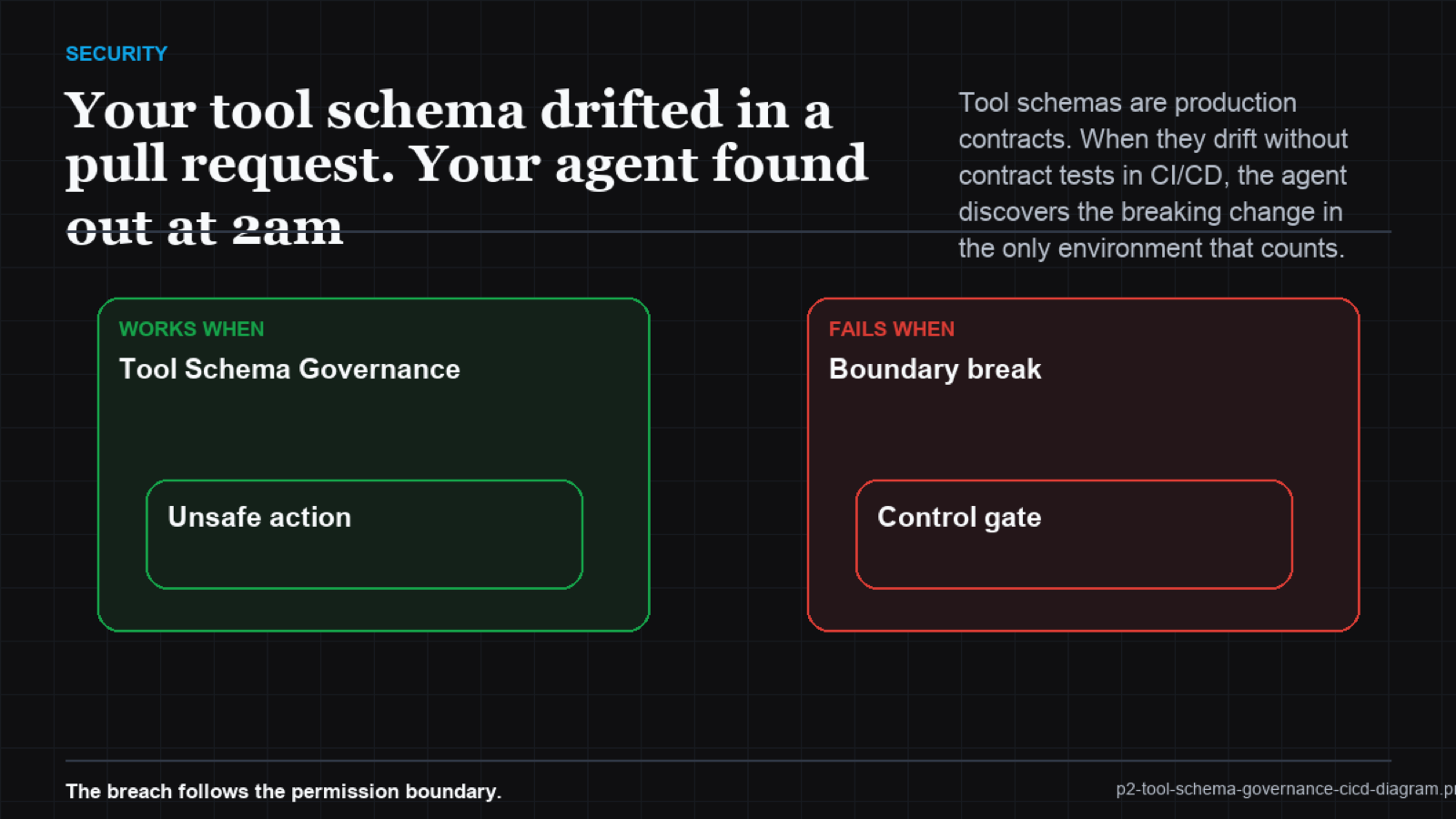
A renamed response key breaks the agent at 2am; an upgrade never tests the contract, so the rework waits in production until boundary tests catch it. (DORA 2024 State of DevOps)
In traditional software, a service consuming an API typically has typed client libraries that surface breaking changes at compile time. Agent tool wrappers are rarely typed in this way. The tool schema is usually a JSON document that the agent framework interprets at runtime. When the schema changes, the agent does not fail at build time. It fails at runtime, often in ways that produce no error code because the agent still sends a valid HTTP request that the API processes without complaint, returning data in the new format that the agent's parser did not expect.
The additional complexity is organizational: in large enterprises, the team owning the CRM API and the team deploying the sales agent may not have a formal dependency tracking relationship. The CRM team adds a required field to the contact update endpoint. The agent team's integration tests run against a sandbox that still has the old schema. The change ships. The agent's contact update calls start failing in production.
Contract testing as the governance layer
Consumer-driven contract testing, where the consuming service (the agent) defines its expectations of the provider (the tool API) and both sides test against the contract in CI, is the standard engineering practice for preventing this class of failure. For agent-tool boundaries, this means the agent team maintains a contract file specifying which fields it uses, which response fields it depends on, and which schema version it was developed against. The tool team runs the agent's contract tests before deploying schema changes. Breaking changes require contract version negotiation before the tool changes can deploy.
Schema governance options by maturity level
| Maturity level | Approach | What it catches | What it misses |
|---|---|---|---|
| Basic | Schema version pinning in agent config | Version mismatch on deploy | Same-version schema changes |
| Intermediate | Automated schema diff alerts on PR | Any schema change in tool API | Behavioral changes without schema change |
| Advanced | Consumer-driven contract tests in CI | Breaking changes to agent-used fields | Semantic changes within valid schema |
| Comprehensive | Contract tests plus semantic response validation | Breaking and semantic changes | Novel failure modes without prior pattern |
VibeModel's Pattern Intelligence Layer adds a production-layer signal on top of CI-time contract testing. By monitoring which tool response schemas the agent actually receives and comparing them to the schemas it was tested against, it detects schema drift that slipped through pre-production checks. This is the production safety net for the schema governance that every agent-tool boundary needs, but not every team has built yet.
Frequently asked questions
How do we implement consumer-driven contract tests for agent-tool boundaries specifically?
Tools like Pact (pact.io) implement consumer-driven contract testing for HTTP APIs and can be applied to agent tool calls. The agent team defines the contract; the tool team runs it in their CI. The integration requires coordination between teams but produces a formal dependency relationship that prevents unilateral schema breaks.
What if the tool API does not support versioning?
Create your own versioning layer in the tool wrapper. The wrapper can maintain backward-compatible handling for known schema variants and alert when it encounters an unexpected variant. This is less elegant than upstream versioning but provides the same production protection.
Should tool schema tests run in the agent's CI or the tool team's CI?
Both, via consumer-driven contract testing. The agent team's CI verifies the tool's current behavior matches the contract. The tool team's CI verifies their changes do not break the agent's contract. Each team owns the test that protects their deployment.