


Key facts.
- Rigorous, blameless postmortems separate teams that keep failing from teams whose reliability climbs. source
- A post-incident review is a blameless, evidence-based retrospective that turns insights into tracked changes, and that means observability has to centralize the telemetry and export it for the review. source
- The learning loop is concrete: incident, observability collects evidence, postmortem drafted, blameless review, action items with owners and deadlines, remediation tracked, runbooks and SLOs updated, then monitor for recurrence. source
- Without proper observability and accountable action items, the cycle repeats, the analysis never reaches the real cause. source
- No trace means the postmortem blames "the model," the fix is a band-aid, the incident returns. A better model won't break it: on OSWorld it finishes ~12% of tasks. (source)
Why does a shallow postmortem guarantee a repeat?
Because a postmortem reasons from what it can see. Standard logs and metrics show the symptom, a wrong output, not what caused it. Not the bad retrieval. Not the flawed assumption in planning. Not the wrong tool call. With only the symptom, "root cause" stays at the surface. A surface cause gets a surface fix. The underlying behavior is untouched. The same failure comes back on the next input that triggers it, costs the same investigation time, and erodes a bit more trust. Nobody learns. Everyone just re-discovers the same gap.
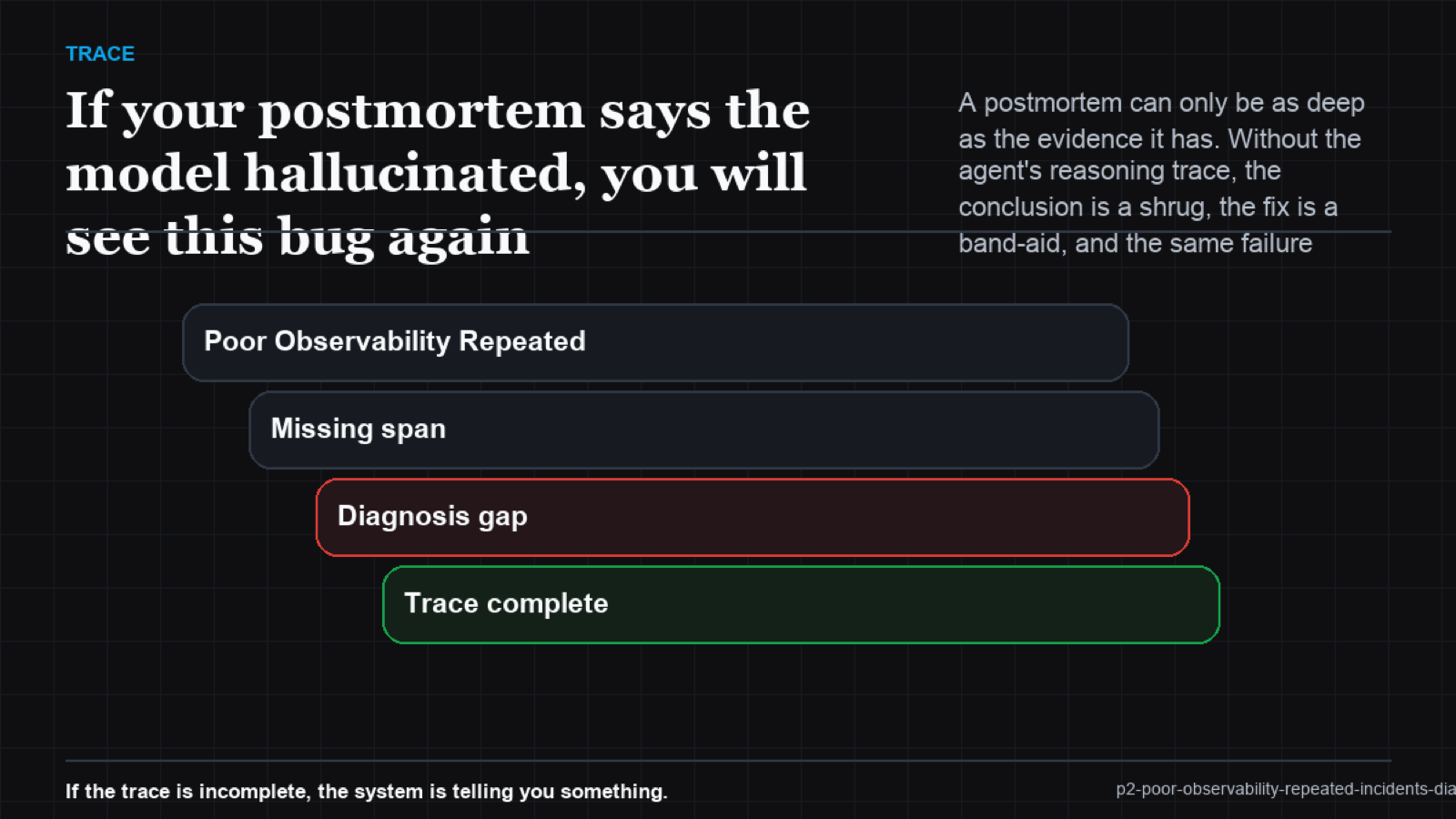
The fix is to give the postmortem real evidence. For an agent, that means the reasoning trace: what context it had, the plan it formed, its confidence, the alternatives it passed on. With that in front of the review, "the model hallucinated" becomes "it pulled the wrong record at step two and never reconsidered", a cause you can actually fix.
What does it take to actually close the loop?
Evidence, ownership, and follow-through, in that order. Observability captures the full trace of the incident including the reasoning, so the review has something real. The blameless postmortem turns that into a cause and action items with named owners and deadlines, not a wiki entry nobody checks. Remediation goes into the backlog. Runbooks and SLOs get updated. Then you monitor for recurrence to confirm the fix held. Skip the evidence step and everything after it runs on a guess. Vendor auto-postmortem features help with drafting. The human review and tracked accountability are what actually change behavior.
| Step | With observability | Without it |
|---|---|---|
| Find the cause | Reasoning trace shows the real chain | Vague: "model hallucinated" |
| Action item | Targets the actual decision that failed | Band-aid on the symptom |
| Recurrence | Monitored and confirmed fixed | Same failure returns in days |
| Team trajectory | Reliability rises over time | Same incidents, forever |
Closing this loop is what the Pattern Intelligence Layer is built for. Reliability at the pattern level means every incident leaves a complete, analyzable record of agent behavior, a failure becomes a pattern you fix once, not a surprise you re-investigate every time it comes back. The gap between a team whose reliability climbs and one stuck on a treadmill isn't talent or model choice. It's whether the evidence was there to learn from.
Frequently asked questions
Why do our postmortems keep concluding "the model hallucinated"?
That's all the evidence supports. Without the reasoning trace, you see the wrong output but not the decision behind it, so the cause stays vague and the fix is a band-aid.
What turns an incident into actual learning?
Evidence, a blameless review, action items with owners and deadlines tracked to completion, then monitoring for recurrence. Missing any of these breaks the loop.
Can an automated postmortem tool replace this?
It helps with the write-up. The human review and tracked accountability are what actually change behavior. Use automation for drafting, not for the decision.