


Key facts.
- PlanBench documents real LLM planning limitations, consistent with agents repeating steps and pursuing dead ends not progressing.source
- ReAct shows interleaving reasoning, acting and observation with feedback reduces aimless behavior, evidence the failure is about planning structure.source
Why does weak planning cause loops?
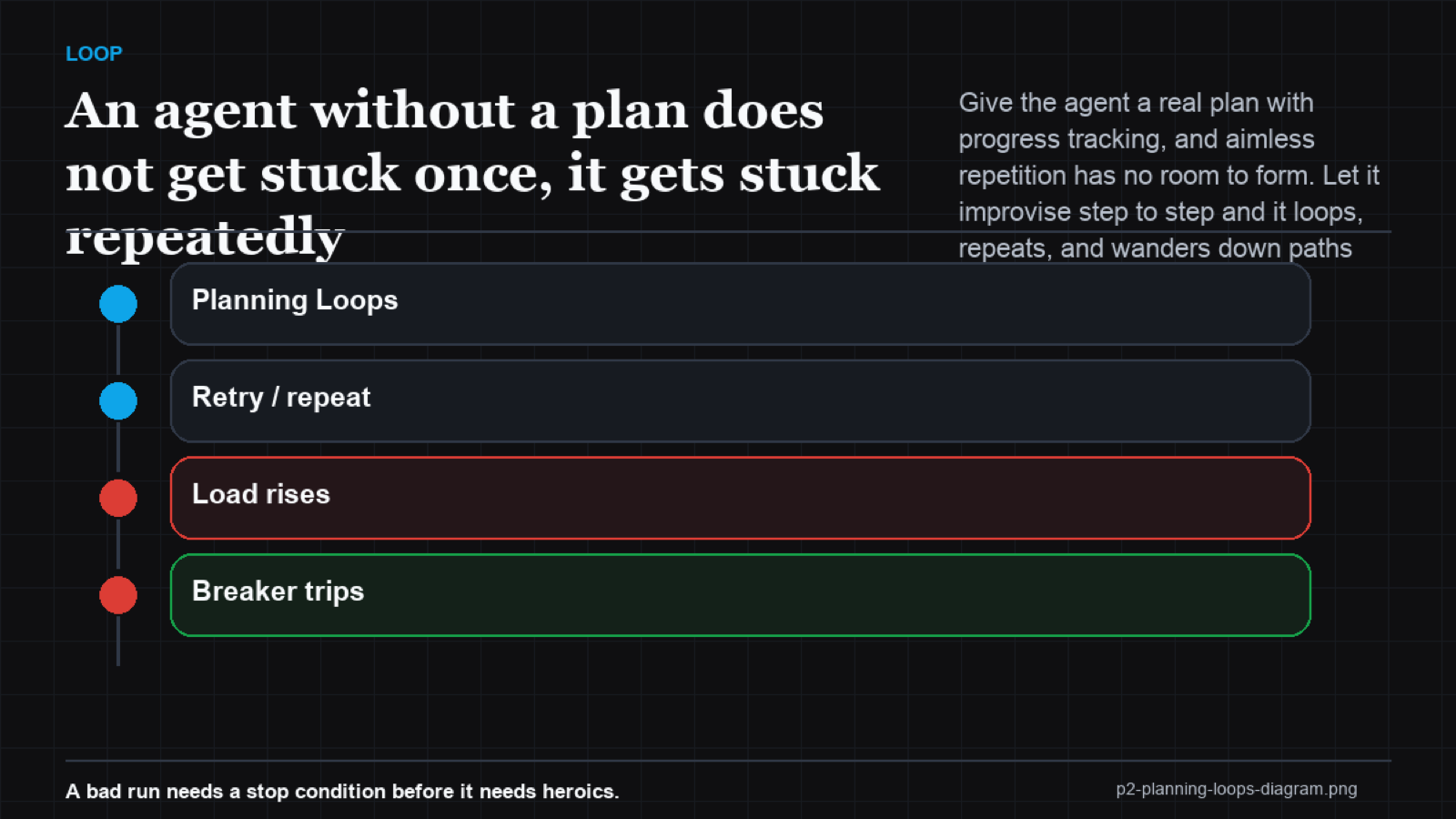
An agent that improvises each step without an explicit plan has no memory of strategy, only of the immediate context. It can take a step, get a result and decide the same next step again, because nothing tells it that step already failed. It can oscillate between two approaches. It can wander down a path that does not advance the goal because it never had a notion of the goal-directed plan to deviate from. This is the behavioral face of the planning limitations PlanBench documents: the model is not reliably tracking what it has tried and what remains, so it repeats and wanders. The loop is not random. It is the predictable result of acting without a plan to act against.
Structure fixes this. An explicit plan gives the agent a notion of the steps and their order. Progress tracking gives it a record of what is done, what failed and what is left, so it does not re-attempt a dead path or lose the thread. The ReAct pattern of interleaving reasoning, acting and observation with feedback is one concrete way to give the loop this structure, and the fact that it reduces aimless behavior is the evidence that the problem was structural. Combined with the termination and progress checks any production agent needs, an explicit plan with tracking is what turns an agent that gets stuck repeatedly into one that makes steady progress toward the goal.
What structure stops the looping?
| Element | Improvise each step | Plan with tracking |
|---|---|---|
| Strategy | None, step to step | Explicit plan |
| Progress | Not tracked | Done, failed, remaining |
| Failed step | Re-attempted | Recorded, avoided |
| Result | Loops and wanders | Steady progress |
An explicit plan with progress tracking works best when there is a clear definition of what progress toward the goal means. VibeModel provides that as the Pattern Intelligence Layer. By making the success pattern explicit, it lets the agent and the system tell whether each step actually advances toward the goal. A step that does not is recognized rather than repeated, and the planning structure that prevents loops has a real target to track against.
Frequently asked questions
Does a smarter model stop the agent looping?
PlanBench documents the loops weak planning makes; a stronger model loops more confidently, so the retries are structural. (arXiv:2206.10498)
Why does the agent repeat steps?
Because without a plan and progress tracking it has no record that a step already failed, so it can decide the same next step again, consistent with documented planning limitations.
How does an explicit plan help?
It gives the agent a strategy and a record of what is done, failed and remaining, so it does not re-attempt dead paths or lose the thread.
Is this the same as a termination check?
Related but broader. Termination checks stop a runaway loop; an explicit plan with tracking prevents the aimless repetition from forming in the first place.