


Key facts.
- One vendor dataset: Sherlocks.ai analyzed 73 production agent incidents (January to May 2026). Observability failures without reasoning traces averaged 4.2 hours MTTR, the slowest failure category in their stack.source
- The same dataset reports incidents with full decision-trace logging resolving in under an hour, with schema-validated tool-call failures around 54 minutes.source
- The mechanism is general: the investigation and root-cause phase typically dominates MTTR, so the win comes from cutting diagnosis time, which traces do directly.source
- These observability failures often surface only through downstream business signals (a support ticket, a KPI dip), which is why they sit undetected and then take longest to resolve.source
Why a missing trace costs hours, not minutes
Without it, you work backward from effects. Bad output, but did the planning step aim at the wrong goal? Did retrieval return the wrong context? Did the agent misread a tool result? No recorded reasoning means guessing. Re-run and hope it fails the same way, it usually won't, agents are non-deterministic. Read scattered logs that show actions but not intent. Try to reconstruct the decision path from fragments. That reconstruction is the hours. A recorded trace collapses it. The decision path is right there: what the agent considered, what it chose, what tipped it.
The 4.2-hours figure is one team's dataset. Don't treat it as a law. The pattern generalizes. Diagnosis is most of any incident's cost, and a reasoning trace is what turns diagnosis from reconstruction into reading. True whether your number is 4.2 hours or something else.
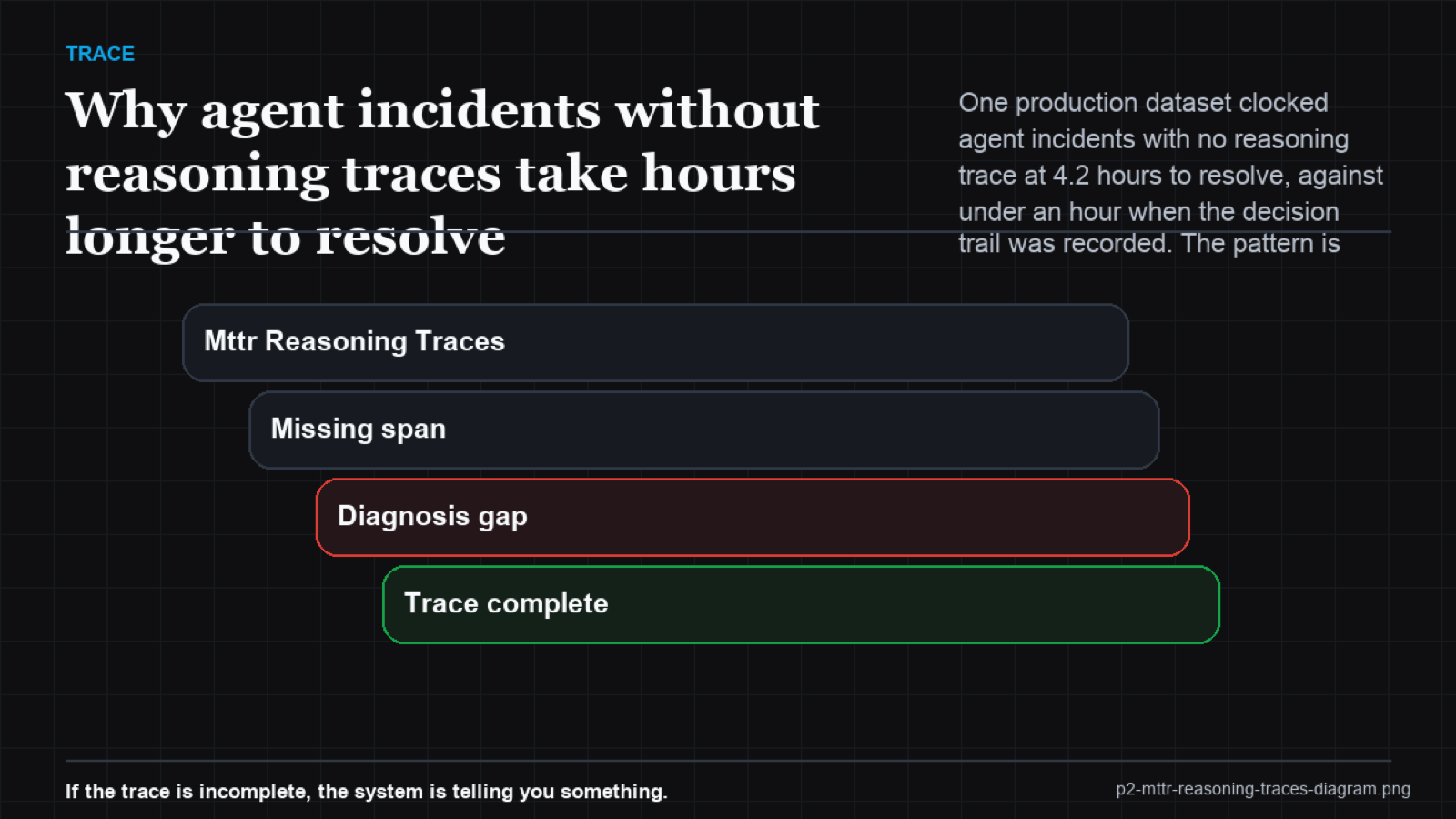
What you record to get the short bar
The decision trail, not just the actions. Capture the agent's plan, the candidate tools it weighed, which one it chose and with what arguments, the tool response, the next decision, and the reasoning that linked them, all stitched under one task trace. OpenTelemetry's GenAI conventions give you a vendor-neutral way to do this, so the trace lives in whatever monitoring stack you already run. When the incident lands, open the trace, walk from the wrong output back to the deciding step. Done. The fix is whatever it is. The hours you save are the hours you'd have spent finding the cause.
| Phase of resolution | Without reasoning trace | With reasoning trace |
|---|---|---|
| Detect | Often via support ticket or KPI | Earlier, via trace anomalies |
| Reproduce | Hard, non-deterministic | Not needed, run is recorded |
| Find root cause | Reconstruct from effects (hours) | Read the decision path (minutes) |
| Fix | Same once cause is known | Same once cause is known |
This is what the Pattern Intelligence Layer keeps ready before the incident. Reliability at the pattern level means the reasoning behind every decision is captured and replayable, it's a property of how the agent runs, not something you bolt on after a bad one. The model can change, the agent can scale, but the recorded decision trail is what keeps your resolution time on the short bar.
Frequently asked questions
Is the 4.2-hour number a benchmark I can quote as fact?
Treat it as one vendor's reported incident dataset (Sherlocks.ai, 73 incidents), not an audited industry benchmark. The directional point, that missing traces lengthen resolution, is what generalizes.
Why is reproduction so hard for agents?
Identical inputs can yield different decisions, so a failure may not recur on demand. The recorded trace of the actual failing run is often your only reliable evidence.
Will a better model make this unnecessary?
No. On TRAIL, even the best model localizes the failing step only ~11% of the time, so you will still be debugging. The trace is what makes that debugging fast regardless of model.