


Key facts.
- Research on the generator-verifier gap shows models verify outputs at a different level than they generate them, so verification effectiveness is a distinct, measurable capability. source
- TRAIL provides a taxonomy of agent-trace errors and 148 human-annotated traces for localizing them, evidence that oversight quality can be measured, not just assumed. source
Why measure oversight, not just the agent?
Most teams grade the agent: accuracy, task completion, latency. That tells you how often the agent is right and nothing about what happens when it is wrong, which is the part that actually hurts. If your human reviewers catch 90% of the agent's errors, you have a very different system than if they catch 40%, even with the identical agent. Yet almost nobody measures the catch rate, the time to catch or the rate at which reviewers wave through confident wrong answers. The generator-verifier gap research is why this blind spot matters: checking is a separate skill from doing, so you cannot infer oversight quality from agent accuracy.
TRAIL shows the measurement is feasible. If agent-trace errors can be taxonomized and localized by annotators, then oversight effectiveness, how reliably your humans and checks find those errors, is a metric you can build. Adding it changes the management picture: now you can see whether a drop in incidents came from a better agent or better oversight and you can invest in whichever half is weak instead of guessing.
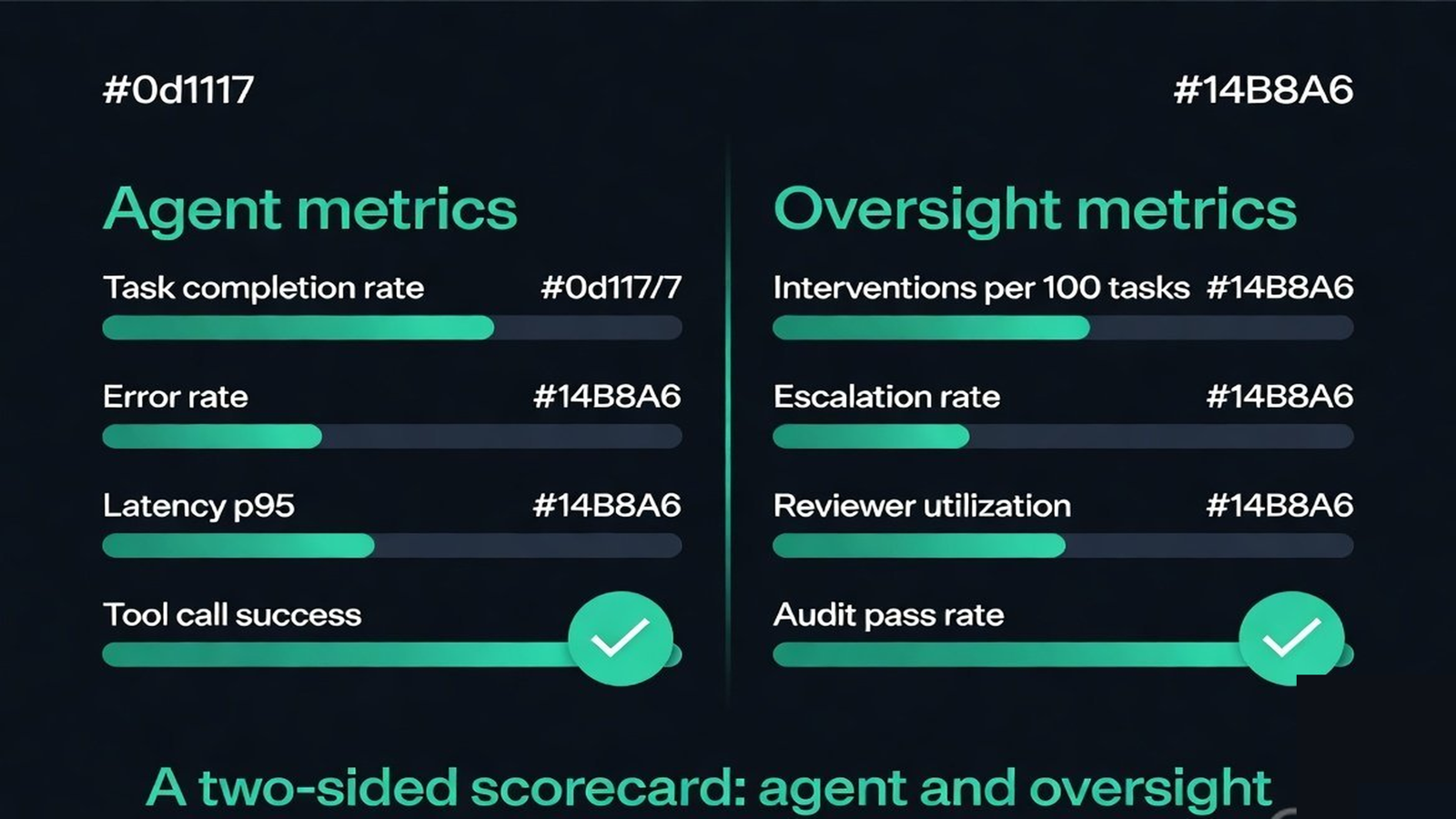
What belongs on the oversight side of the scorecard?
| Layer | Common metric | Missing metric |
|---|---|---|
| Agent | Accuracy, completion | (tracked) |
| Oversight | Rarely tracked | Catch rate, time to catch |
| Failure | Incidents counted | Wrong-answers waved through |
Measuring oversight requires knowing which agent behaviors most need checking, which is a pattern judgment the Pattern Intelligence Layer makes legible. VibeModel surfaces where the agent is reliable and where it is not at the pattern level, so you can point oversight at the patterns that matter and measure how well it holds there, turning human-in-the-loop from a comforting phrase into a number you manage.
Frequently asked questions
Why is agent accuracy not enough?
Because it says nothing about what happens when the agent is wrong. Two systems with the same agent and different oversight catch rates have very different real risk.
Can oversight really be measured?
Yes. Work like TRAIL shows agent-trace errors can be taxonomized and localized, so catch rate and time-to-catch are buildable metrics.
What is the generator-verifier gap?
The finding that a model's ability to verify an answer differs from its ability to produce one, which is why verification effectiveness is its own thing to measure.